
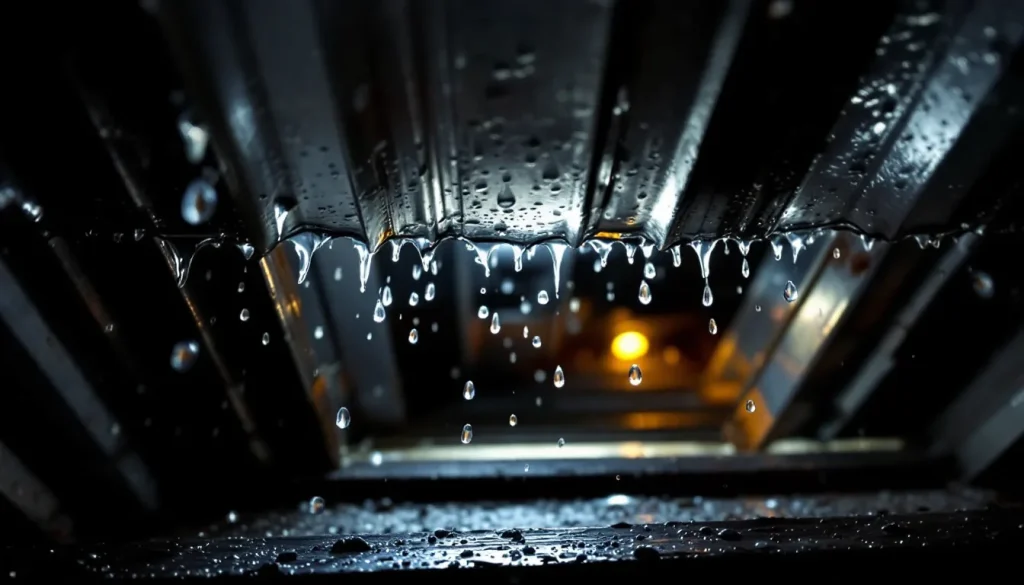
Metal roof condensation in 2026 is the most common metal roof problem after install. It happens when warm humid air inside the building hits the cold underside of the metal panel and condenses into water droplets that fall like rain into the attic or structure below. The fix is either closed cell spray foam under the deck ($3 to $7 per square foot), a factory applied drip stop coating on the panel ($0.30 to $0.80 per square foot when ordered with new panels), or a vapor permeable underlayment installed during the original build ($0.40 to $1.20 per square foot). Most homeowners discover the problem after the first cold snap when water starts dripping from light fixtures or showing up as ceiling stains, and then assume the roof is leaking when it is actually sweating.
The short version
- Condensation is not a leak. It is moist interior air hitting cold metal and changing to liquid water on the underside of the panel.
- The three permanent fixes are closed cell spray foam under the deck, a factory bonded drip stop membrane on the underside of the panel, or a synthetic vapor permeable underlayment between deck and panel.
- Adding intake and exhaust ventilation alone rarely solves the problem in cold climates but it is usually part of the fix.
- Pole barns, carports, and metal buildings without insulation are the worst offenders because the panel is exposed to interior humidity on one side and 20 degree air on the other.
- Costs run from $1,200 for a small drip stop retrofit on a carport to $14,000 plus for full closed cell spray foam in a 2,400 square foot home.
- Most metal roof warranties exclude condensation damage, so the installer who sold you the panel is rarely on the hook.
Short answer: three fixes that actually work
There are three fixes for metal roof condensation that work reliably in real cold climates, and dozens of internet remedies that do not. The three that work are closed cell spray foam applied to the underside of the roof deck, a factory bonded drip stop membrane (sometimes branded as Dripstop, Condenstop, or similar) laminated to the underside of the panel before install, and a synthetic vapor permeable underlayment laid over the deck before the panel goes on. Each of these breaks the chain in a different place. Spray foam stops interior air from ever reaching the cold metal. Drip stop catches and re evaporates the condensation that does form on the panel. Vapor permeable underlayment lets the deck and the air gap above it dry out instead of trapping moisture.
If you have an existing metal roof and you cannot afford to remove the panels, closed cell spray foam from below is almost always the right answer. If you are buying a new building or replacing the roof entirely, ordering panels with factory bonded drip stop is the cheapest long term fix and the easiest to install.
Why metal roof condensation happens
Condensation is a physics problem, not a roofing defect. Air can only hold so much water vapor at a given temperature. Warmer air holds more, colder air holds less. The temperature at which a given parcel of air becomes saturated is called the dew point. When 70 degree indoor air at 50 percent relative humidity hits a surface at 50 degrees or below, that air dumps its excess moisture out as liquid water on the cold surface. On a winter night in Minnesota, the underside of a metal panel can sit at 15 to 25 degrees while the interior air is 68 to 72 degrees. Every cubic foot of indoor air that touches that panel is going to leave behind water.
Three things make condensation worse: high indoor humidity (showers, cooking, indoor plants, unvented gas heaters, wet concrete floors in pole barns), low outdoor temperature, and a metal panel that goes directly from cold outside air to warm inside air with nothing in between. Asphalt shingle roofs over a vented attic almost never have this problem because the attic acts as a buffer zone. Metal panels installed directly over purlins with no insulation and no air space are the textbook worst case.
Why it is worse with metal than asphalt
Metal has roughly 1,500 times the thermal conductivity of asphalt shingles. A 26 gauge steel panel in a 20 degree night cools down to within a few degrees of ambient air temperature within minutes. Asphalt shingles, with their granular surface and the felt or synthetic underlayment beneath them, retain heat much longer and present a warmer surface to interior air. Metal also has essentially zero water absorption capacity. When water condenses on the underside of an asphalt shingle, the felt or synthetic underlayment can absorb a small amount of it and re evaporate it later. When water condenses on metal, it has nowhere to go except down. That is why a 30 by 40 pole barn with no condensation control can drip enough overnight to form puddles on a concrete floor.
Fix 1: closed cell spray foam under the deck
Closed cell spray polyurethane foam at 2 inches thick has an R value of about 12 to 14 and a perm rating below 1, which means it is both a thermal barrier and a vapor barrier. Sprayed directly to the underside of the metal panel or the wood deck, it eliminates the temperature differential and blocks interior moisture from ever reaching the cold side. This is the most expensive option at $3 to $7 per square foot installed, but it is also the most reliable. A 2,400 square foot roof costs $7,200 to $16,800 for a 2 inch application.
Two warnings. First, do not use open cell foam for this application. Open cell foam has a perm rating of 10 or higher, which means water vapor passes through it freely and condenses on the cold metal behind it, hidden from view. Several insurance claim studies in the last three years have flagged hidden rot caused by open cell foam misapplied to metal roof undersides. Second, in vented attics, closed cell foam on the deck creates an unvented assembly. Remove the soffit and ridge vents or your assembly will not work as designed. See attic ventilation for the relevant code path.
Fix 2: drip stop coating on the panel
Drip stop is a felt membrane laminated to the underside of a metal panel at the manufacturing plant. It looks like a thin gray fleece glued to the back of the steel. When humid air contacts the underside of the panel, water condenses inside the fleece rather than on the smooth metal. The fleece holds the water until daytime temperatures rise and the moisture evaporates back through the same surface. It is the cheapest fix at $0.30 to $0.80 per square foot of panel when ordered with new panels. It cannot be retrofitted to an existing roof from the top, although some installers will spray a similar product from below.
Drip stop has limits. It is rated for a fixed amount of overnight condensation, roughly 1 ounce per square foot. In extreme conditions, such as an unheated pole barn in a Wisconsin January with 80 percent indoor humidity, the membrane saturates and water still drips. It also stops working if you cover it with insulation that traps moisture against it.
Fix 3: vapor permeable synthetic underlayment
A vapor permeable synthetic underlayment installed between the wood deck and the metal panel does two things. It drains any liquid water that forms on the underside of the panel out to the eaves, and it lets water vapor in the assembly pass through to the outside. Products in this category include Solitex Mento 1000 and similar high perm membranes (typically 38 perms or higher). At $0.40 to $1.20 per square foot installed, this is the middle cost option. It only works during the original install or a full metal roof installation redo, since the panels have to come off to lay the membrane.
This is not the same product as standard 30 pound felt or standard synthetic underlayment, which have perm ratings below 1 and trap moisture. Asking your installer for “synthetic underlayment” is not enough. Ask for the perm rating in writing.
Ventilation is part of the fix, not all of it
Adding intake at the soffits and exhaust at the ridge is almost always part of the fix, but it is rarely the whole fix. Attic ventilation moves air across the underside of the panel, which helps dry it out, but it does not address the root cause (warm humid air reaching cold metal). In a heated, humidified, conditioned home in a cold climate, more attic ventilation can actually make condensation worse by pulling more interior air up through ceiling penetrations and bath fans dumped into the attic.
The right ventilation strategy depends on the assembly. If you have closed cell foam against the underside of the deck, the assembly is unvented and you do not need soffit vents at all. If you have a vented attic with insulation on the ceiling and the metal roof above an air gap, you need a balanced 1:300 net free area split roughly 50/50 between intake and exhaust per IRC R806.
Fix cost comparison
| Fix | Cost per sq ft | 2,400 sq ft total | Effective in extreme cold | Retrofit possible |
|---|---|---|---|---|
| Closed cell spray foam, 2 inches | $3 to $7 | $7,200 to $16,800 | Yes | Yes, from below |
| Factory drip stop on panel | $0.30 to $0.80 | $720 to $1,920 | Limited (saturates) | No, new panels only |
| Vapor permeable underlayment | $0.40 to $1.20 | $960 to $2,880 | Yes | No, requires tear off |
| Add ventilation alone | $0.15 to $0.50 | $360 to $1,200 | No | Yes |
| Dehumidifier inside building | varies, $300 to $1,200 unit | $300 to $1,200 | Partial | Yes |
| Spray applied drip stop from below | $1.50 to $3.50 | $3,600 to $8,400 | Limited | Yes |
Code requirements: IRC and IBC references
| Code section | Requirement | Application |
|---|---|---|
| IRC R806.1 | Required attic ventilation for unconditioned attics | Vented metal roof assemblies |
| IRC R806.5 | Unvented attic assembly rules (closed cell foam) | Spray foam metal roof fix |
| IRC R905.10 | Metal panel roof installation requirements | All metal roof installs |
| IBC 1203.2 | Ventilation requirements for enclosed attic and rafter spaces | Commercial metal roofs |
| IECC R402.4.1 | Air sealing requirement, ceiling to attic | Reduces interior air reaching cold panel |
| ASTM E96 | Standard test method for water vapor transmission | Underlayment perm rating verification |
Code references matter when you are buying a building, selling a building, or filing an insurance claim related to metal roof moisture damage. A panel installed without compliance to IRC R905.10 or without an unvented attic assembly per R806.5 is a defect that the seller, builder, or installer may be liable for. For most existing homes, the code path is what your insurance carrier will look at first when evaluating coverage.
Pole barn and metal building specifics
Pole barns are the textbook condensation case. A typical pole barn has a metal panel screwed directly to wood purlins with no insulation, no underlayment, and a concrete slab below that pumps moisture into the air for the first 2 years after pour. Add a propane heater, a few wet vehicles, and a tight building envelope, and you have a recipe for dripping rafters every cold morning.
The fix for an existing pole barn is almost always closed cell spray foam at 1.5 to 2 inches against the underside of the panel and the purlins. Cost runs $4 to $6 per square foot of roof area. For a new pole barn, order panels with factory drip stop and add a 6 mil poly vapor barrier under the slab during pour. This combination handles 95 percent of pole barn condensation cases at a fraction of the spray foam cost.
Mobile home metal roof condensation
Mobile homes with original metal roofs often develop condensation problems as the original sealant degrades and interior humidity rises with newer appliances. The standard fix is an elastomeric roof coating system applied to the top side of the metal, which by itself does nothing for condensation. The real fix is interior side: adding rigid foam to the ceiling, sealing penetrations, and running a bathroom vent fan that exhausts outside instead of into the roof cavity. A full elastomeric roof coating with interior air sealing typically runs $2,800 to $6,500 for a single wide.
Carport and open metal condensation: the worst case
An open carport with a metal roof and no walls is the most extreme condensation environment. The panel is exposed to ambient humidity on both sides, and there is no envelope to control. Drips will land on your car hood every cool clear night. The only effective fixes are factory drip stop panels (cheap if you are building new) or a spray applied drip stop coating from below ($1.50 to $3.50 per square foot). Spray foam does not work because there is no warm side to insulate from. Some homeowners give up and accept the drips, parking the vehicle further back from the eave line.
When existing metal roof can be fixed without removal
If your existing metal roof is structurally sound and the panels are not corroded, you almost never need to remove them to solve condensation. Closed cell spray foam applied to the underside of the deck or directly to the panel from below handles the vast majority of cases. The decision tree:
| Condition | Recommended fix | Removal needed? |
|---|---|---|
| Vented attic, ceiling insulated, drips on insulation | Air seal ceiling, balance ventilation | No |
| Cathedral ceiling, drips between rafters | Closed cell spray foam underside of deck | No |
| Pole barn, drips from purlins | Closed cell foam on purlins and panel | No |
| Mobile home, ceiling stains | Interior air seal + roof coating | No |
| Panel corroded from underside | Full tear off, vapor permeable underlayment, new panel with drip stop | Yes |
| Carport with no ceiling | Spray drip stop from below or replace with drip stop panels | Maybe |
If you do end up needing a full replacement, factor in tear off roof cost and any rotted roof decking hiding underneath the existing panel. Choosing the right contractor matters more for metal than for asphalt because the failure modes are different. See how to choose a roofing contractor for the vetting checklist.
Signs and symptoms checklist
| Symptom | Condensation | Roof leak |
|---|---|---|
| Timing | Cold clear nights, winter mornings | During or right after rain |
| Pattern | Multiple spots along panel ribs | One or two localized spots |
| Water appearance | Clean, clear, no debris | Often discolored or with debris |
| Seasonal pattern | Worst in winter | Tracks storm events |
| Indoor humidity | Worse when indoor humidity high | No relationship to indoor humidity |
| Where it shows up first | Light fixtures, ceiling fan blades, screws | At wall corners, around penetrations |
| Drying time | Stops the moment outdoor temp rises | Continues until repair is made |
Insulation R value guidance by climate zone
| Climate zone | Roof R value target | Minimum closed cell foam thickness | Recommended approach |
|---|---|---|---|
| 1 (Miami, Houston) | R 30 | 2 inches plus loose fill | Drip stop panel sufficient |
| 2 (Atlanta, Phoenix) | R 38 | 2.5 inches plus loose fill | Drip stop or 2 inch foam |
| 3 (Memphis, Nashville) | R 38 | 3 inches plus loose fill | Drip stop or 2.5 inch foam |
| 4 (St Louis, NYC) | R 49 | 3.5 inches plus loose fill | Closed cell foam preferred |
| 5 (Chicago, Boston) | R 49 | 4 inches plus loose fill | Closed cell foam required |
| 6 (Minneapolis, Bismarck) | R 60 | 5 inches plus loose fill | Closed cell foam required |
| 7 (Duluth, Fairbanks) | R 60 plus | 5+ inches plus loose fill | Closed cell foam plus interior vapor retarder |
Signs you are dealing with condensation, not a leak
Five tells separate condensation from an actual leak. First, condensation shows up after a cold clear night, not after rain. Second, it shows up in multiple spots at once, often in a pattern that follows the panel ribs. Third, it stops the moment outdoor temperatures rise above the indoor dew point. Fourth, it gets worse when indoor humidity is high, such as after showers or in winter when a humidifier is running. Fifth, the water is clean (no asphalt staining, no debris), unlike a leak that picks up dirt as it travels through the assembly. If you see water in any of these patterns, fix the condensation source before calling a roofer about a leak. For actual leaks, see how to fix a roof leak and roof leak repair.
FAQs
Is metal roof condensation covered by warranty?
Almost never. Most metal panel manufacturers explicitly exclude condensation damage from their finish and substrate warranties because they consider it a building science problem rather than a product defect. Read the warranty document, not the brochure.
Will adding more attic ventilation alone stop condensation?
Rarely. In cold climates, more ventilation can pull more interior moist air up through ceiling penetrations and make the problem worse. Ventilation is part of the fix in vented assemblies, not a standalone solution.
How much does it cost to fix metal roof condensation?
$1,200 to $16,800 depending on building size and method. A small pole barn drip stop retrofit runs $1,200 to $3,000. Full closed cell spray foam on a 2,400 square foot home runs $7,200 to $16,800.
Can I spray foam over an existing metal roof from the inside?
Yes, but use closed cell only, and remove or seal any existing attic ventilation so the assembly works as designed. Open cell foam will trap moisture against the cold panel and cause hidden rot.
Does drip stop coating work in extremely cold climates?
Yes for most homes, no for high humidity outbuildings. Drip stop is rated for about 1 ounce of overnight condensation per square foot. In an unheated pole barn at high interior humidity, it saturates and drips anyway.
Will a dehumidifier fix metal roof condensation?
Partially. Lowering interior relative humidity below 35 percent in winter reduces the dew point and may eliminate condensation on its own in mild cases. In colder climates with humid interiors, you still need an assembly fix.
Why does my new metal roof have condensation when my old asphalt roof did not?
Metal has 1,500 times the thermal conductivity of asphalt. The underside of the panel reaches the dew point on most cold nights while asphalt does not. The fix is to address the assembly, not to switch back.
Can I retrofit factory drip stop to existing panels?
No. The membrane is laminated to the panel at the manufacturing plant before forming. The closest retrofit is a spray applied drip stop product applied from below, which performs at roughly 60 to 70 percent of factory drip stop in field tests.
Related reading: all roofing guides | metal roof installation | metal roof cost | standing seam metal roof cost | corrugated metal roofing | metal roof colors | attic ventilation | soffit vents | felt vs synthetic underlayment | ice and water shield | signs you need a new roof