
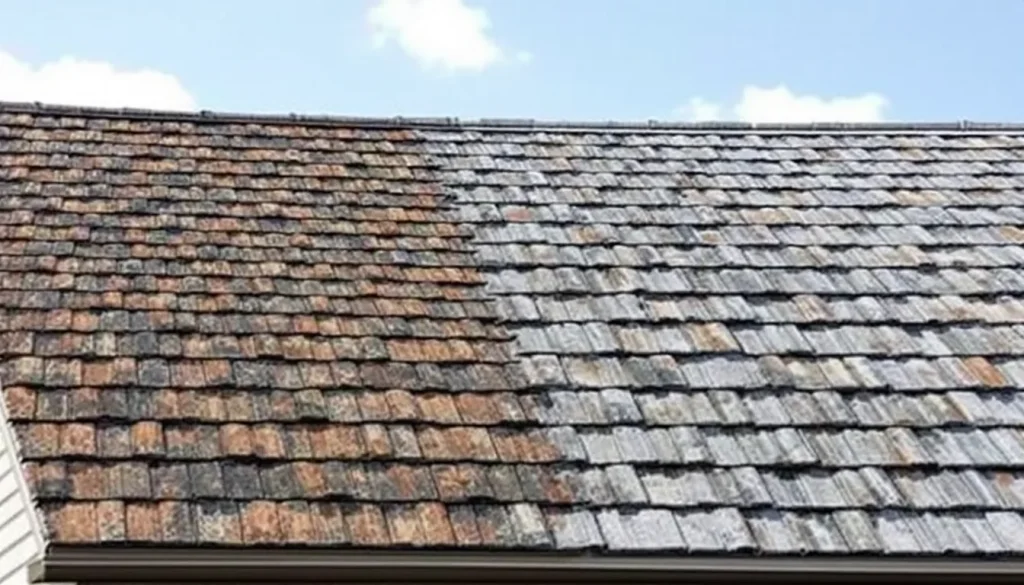
A single slope (see our metal lean-to roof guide) roof replacement in 2026 runs $2,500 to $8,000 on a typical two-slope residential home, covering just one of the two roof faces while leaving the other intact. The scenario comes up more often than most homeowners realize: south-facing slopes age 15% to 25% faster than north-facing slopes from UV exposure, tree shade can preserve one side while the other fails, hail and wind events frequently damage just one face, and original installation errors are often confined to one slope. Replacing only the failed side cuts the cost roughly in half versus a full re-roof, but it carries trade-offs: shingle matching becomes nearly impossible after year 8, insurance carriers often push back on partial claims, and warranty coverage gets murky. Below is when single-slope replacement actually makes sense in 2026, what it costs, and how to avoid the matching headache and insurance fight.
The short version
- Single slope replacement on a typical 1,000 sq ft slope: $2,500 to $8,000 in 2026.
- Per-square-foot pricing runs 10% to 25% higher than full re-roof because of mobilization and minimum charges.
- Best candidate scenarios: south-facing slope failure, single hail-damaged side, tree-shade asymmetry, install-error rebuild.
- Worst candidate scenarios: roof over 12 years old (matching impossible), planned sale within 5 years (buyer pushback).
- Insurance carriers will push back on partial replacement claims and prefer to pay for full replacement.
- Shingle color matching is the largest practical risk. Same product, same color code can look noticeably different from a different production batch.
- Manufacturer warranty typically does not transfer or apply on partial replacements; labor warranty from the contractor is what you actually have.
The short answer: when one slope goes but the other does not
Asymmetric roof failure is common. The two main drivers are sun exposure and physical damage. South-facing slopes in the Northern Hemisphere see roughly twice the UV dose of north-facing slopes over the year, which translates to 15% to 25% faster aging. On a roof installed in 2002, the south slope (see our partial roof replacement) might be at end-of-life by 2024 while the north slope still has 8 to 12 years left. Replacing the whole roof at that point throws away those remaining years on the north side.
Physical damage is the other driver. Hail tracks typically hit one face of a roof harder than the other, depending on storm direction. Wind events often blow off shingles on the windward slope while leaving the leeward slope untouched. A tree limb falling on one side can damage half the roof while the other half is pristine. In these cases, replacing just the damaged side is the obvious cost (for the full data set, see our the full 2026 Roofing Cost Report)-effective move.
2026 pricing table: single slope replacement by slope size
| Slope area | Asphalt architectural (mid-tier) | Asphalt premium (Class 4 / Pinnacle Pristine) | Standing seam metal |
|---|---|---|---|
| 500 sq ft (small slope, garage or ranch wing) | $1,800 to $3,500 | $2,400 to $4,500 | $5,000 to $9,500 |
| 750 sq ft (typical secondary slope) | $2,400 to $4,500 | $3,200 to $5,800 | $7,000 to $13,000 |
| 1,000 sq ft (typical primary slope, two-slope home) | $2,800 to $6,500 | $4,000 to $8,500 | $9,500 to $17,500 |
| 1,250 sq ft (large primary slope) | $3,500 to $8,000 | $5,000 to $10,500 | $11,500 to $21,500 |
| 1,500 sq ft (very large primary slope or multi-section) | $4,200 to $9,500 | $6,000 to $12,500 | $14,000 to $26,000 |
The numbers above include tear-off, underlayment, ice and water shield at eaves and the ridge interface, drip edge, shingles, ridge cap, flashing where needed, and labor. They exclude decking replacement beyond 2 to 3 sheets, chimney work, and skylight replacement. For comparison to full re-roof pricing, see our cost to redo roof guide.
Why per-square-foot pricing on partial work runs higher
A single slope replacement always costs more per square foot than a full re-roof. Three reasons:
Mobilization cost is the same
Crew, truck, dumpster, materials delivery, and supervision cost the same whether you are doing one slope or two. Spreading those fixed costs over fewer squares means each square is more expensive.
Tie-in work at the ridge or hip is added labor
Where the new slope meets the existing slope (at the ridge, hip, or valley), the roofer has to carefully integrate new shingles with old. New ridge cap has to overlap old field shingles. Old ridge cap on the unreplaced slope may need to come off and be replaced. This adds 4 to 8 hours of skilled labor on a typical slope.
Material waste is higher
Cutting bundles for one slope generates more waste percentage than cutting for a full roof, because there is less surface to absorb the cuts efficiently. Waste factor on a partial install typically runs 15% to 20% versus 10% to 12% for a full re-roof.
The practical math: a $14,500 full re-roof on a 2,000 sq ft home is $7.25 per square foot. The same shingles on a 1,000 sq ft single slope of that same home runs $4,500 to $5,500, or $4.50 to $5.50 per square foot, which is 70% to 80% of the full job for 50% of the surface. The contractor is doing more than half the work for half the area because of the fixed costs and tie-in complexity.
When single slope replacement actually makes sense in 2026
South-facing slope failure on a North-South gable
The most common honest scenario. A 22-year-old roof on a North-South gable home in Phoenix, Dallas, or Denver: the south slope has hit end-of-life (granule loss, brittle shingles, exposed asphalt) while the north slope still looks fine. Replacing just the south side costs $4,500, lets the north side run another 10 years, and saves the homeowner $9,500 over the next decade. When the north slope eventually fails, that gets replaced too, and the warranty cycle starts on each slope at a different time.
Storm damage to one face
Hail and wind events often damage one side. Insurance carriers typically prefer to pay for the damaged slope only, especially when the homeowner has a high deductible. The math: a $2,500 deductible plus $4,500 in single-slope replacement vs paying out of pocket for a $14,500 full re-roof is the case for partial. Many homeowners take the partial settlement and use the savings on other home priorities.
Installation error confined to one slope
Roof installation crews sometimes have a bad day on one slope: wrong nail pattern, missed sealing strip, gaps in the starter course. The result is one slope failing 8 to 15 years before the other. Partial replacement to fix the bad-day install makes sense, especially if the original contractor still stands behind their warranty.
Tree shade asymmetry
A roof with heavy tree shade on the north side and full sun on the south side will weather asymmetrically. The shaded side may grow moss and algae (treatable, but extends life by reducing UV); the sunny side will age normally. After 25 years, partial replacement on the sunny side leaves the shaded side with another 5 to 10 years.
When single slope replacement does not make sense
Roof is 12+ years old and matching matters
After about year 8, color matching on asphalt shingles becomes difficult. By year 12, it is near impossible: the existing shingles have weathered and lost granules, the new shingles will be visibly more saturated and crisp. The visible color difference between an old slope and a new slope is a real curb-appeal issue. Most home buyers and inspectors will notice and many will ask about it. If you are planning to sell within 5 years, the cost of buyer pushback may exceed the savings versus replacement.
Both slopes are within 5 years of end-of-life
If the failed slope is at end-of-life and the other slope is at year 22 of a 25-year expected lifespan, partial replacement is throwing money away. The second slope will fail soon, requiring another partial replacement with its own mobilization cost. Two $4,500 partials within 5 years is $9,000, which buys you only marginally less than a single $14,500 full re-roof and produces a worse curb-appeal result.
Insurance claim where carrier offers full replacement
Many carriers, especially when significant damage exists on one slope, will agree to full replacement to avoid future shingle-matching disputes. If your adjuster offers full replacement at a price that beats partial out-of-pocket, take the full replacement.
HOA covenants requiring uniform appearance
Some HOA covenants require that all visible roof surfaces appear uniform, which makes partial replacement non-compliant. Check your covenants and HOA architectural review board approval before scoping partial work.
The shingle matching problem
Shingle matching is the practical issue that limits partial replacements. The variables that affect match:
Product still in production
If your existing shingles are GAF Timberline HDZ Charcoal, the product line is current and the color is one of the most common, so a match is likely. If your existing shingles are CertainTeed Landmark TL (discontinued), the closest match is Landmark Premium or Landmark PRO and the discontinued product will not match exactly. Discontinued products are the largest matching headache; expect a 15% to 30% visible difference even with the best available substitute.
Production batch variation
Even when you order the same product in the same color code from the same manufacturer, granule batches vary. Two bundles from different production runs can look noticeably different side by side. A reputable contractor will source bundles from a single batch run, which sometimes requires waiting 2 to 6 weeks for inventory.
Weathering offset
The existing slope has weathered for years; the new slope has not. Even a perfect product match will look fresher and more saturated on the new side for the first 2 to 5 years until it weathers to match. There is no way around this with asphalt. Metal roof replacement is a different story.
Color codes are not standardized across brands
“Driftwood” from GAF and “Driftwood” from CertainTeed are not the same color. If you are switching brands (because the original is discontinued or unavailable), expect a visible mismatch.
The insurance pushback
Insurance carriers in 2024-26 have gotten more aggressive about partial replacement claims for two reasons: (1) carrier costs have risen, so they push for the lowest acceptable settlement, and (2) shingle matching disputes generate downstream complaints and supplements that carriers want to avoid.
Common carrier responses to a partial-damage claim:
- Pay for partial replacement at actual cash value (depreciated price), not replacement cost. This often leaves the homeowner short on out-of-pocket.
- Offer a settlement amount that covers only the damaged slope plus a small percentage allowance for matching.
- Authorize full replacement only if the damage exceeds a threshold (often 25% or 30% of total roof area) or if matching is determined to be impossible.
- Apply a matching clause if your policy includes one (these are increasingly carved out of new policies).
Some states have insurance regulations requiring carriers to pay for matching on partial repairs. Florida, Iowa, and a few others have variations of this rule. The carrier’s obligation depends on policy language and state law. Our filing an insurance claim guide walks through the process. For hail-specific claim thresholds, see how much hail damage to replace a roof.
Worked example: partial replacement on a hail-damaged south slope
A homeowner in Oklahoma City has a 14-year-old GAF Timberline HDZ Charcoal roof on a North-South gable home. A May 2026 hailstorm dropped 1.5-inch hail. The south slope (1,100 sq ft) has 18 visible hits per square; the north slope has 3 hits per square. The adjuster offers $5,800 for partial replacement of the south slope, after the $2,500 deductible.
Contractor quote breakdown:
- Tear-off and disposal (south slope only): $1,000
- Synthetic underlayment: $450
- Ice and water shield at south eave and ridge interface: $650
- GAF Timberline HDZ Charcoal shingles (12 squares plus waste): $1,750
- Starter, ridge cap, drip edge: $550
- Step flashing rebuild at south sidewall: $400
- Pipe boot replacement on south side (2 boots): $350
- Labor (3 crew, 1 day): $1,800
- Permit: $100
- Tie-in work at ridge (integrating new with existing): $500
- 2-year labor warranty
Total: $7,550. Insurance pays $5,800, homeowner pays $2,500 deductible plus $1,750 out of pocket above the settlement. The match quality on Charcoal is acceptable given product still in production; visible difference will fade within 3 years. If the homeowner had pushed for full replacement, the math would have been a $14,500 job with the same $2,500 deductible and a much larger out-of-pocket gap because the carrier would not approve full.
What the contractor needs to do differently on partial work
Source matching shingles from a single batch
A reputable contractor will check current inventory at their distributor and order all bundles from one batch. This requires asking the distributor for the batch number on the bundle wrap and confirming uniform run. Smaller distributors with mixed stock cannot do this. Larger distributors (ABC Supply, Beacon, SRS) typically can but it requires a contractor who will ask.
Cut new shingles to interface cleanly at the ridge
The new field shingles on the new slope must integrate with the existing ridge cap. Options: pull existing ridge cap, replace with new ridge cap matching both new and old field shingles; or weave new ridge cap into existing while creating a clean transition. The first option costs $200 to $400 more and looks better. The second is faster and cheaper but the transition is visible up close.
Reflash all interface points
Where the new slope meets the existing slope at the ridge, hip, valley, or wall, all flashing in those interface zones gets replaced. Cheaping out on flashing here is the most common failure point on partial work.
Document the existing slope condition
Photos of the unreplaced slope at the time of partial replacement are important for future warranty and insurance claims. The contractor should take and provide them. This also protects the contractor against future claims that they damaged the existing slope.
Warranty on partial replacement
Manufacturer warranties on asphalt shingles are typically tied to the original installation date of the roof system. A partial replacement does not start a new warranty period on the partial work; the shingles get the standard manufacturer defect warranty (5 to 30 years depending on product), but the system warranty does not transfer. Premium manufacturer warranties (Golden Pledge, Platinum Preferred, SureStart PLUS) are not available on partial installs.
Labor warranty is what you actually have. A reputable contractor will provide 2 to 5 years of labor warranty on the partial work. Get it in writing on the invoice. Check that the contractor has been in business at least 5 years and has positive reviews; the warranty is only as good as the company.
Code considerations
Most US jurisdictions allow partial roof replacement without special permit requirements beyond the standard re-roof permit. A few jurisdictions require that any roof work bring the entire roof system to current code, which can force flashing and ventilation upgrades on the unreplaced side. Verify with your local building department before scoping.
Decking and structural considerations
Partial replacement includes decking inspection on the replaced side only. If the unreplaced side has decking damage that has not yet manifested in leaks, partial replacement will not catch it. Reputable contractors recommend, at the time of partial replacement, an attic inspection of the unreplaced side from below to check for telegraphing damage. This adds $150 to $350 and is worth it.
FAQ
Can I replace only the back slope of my roof to save money?
Yes, but the savings calculation depends on what is wrong with the front slope. If the front slope has clear life left, partial replacement on the back makes economic sense. If the front slope is also at or near end-of-life, full replacement is the better value because of the mobilization and waste-factor math. For most owner-occupied homes within 5 years of full re-roof timing, full replacement wins.
Will my insurance pay for matching shingles on the unreplaced slope?
Sometimes, depending on policy and state. Many policies in 2024-26 carry a “matching clause” carveout that limits or eliminates carrier obligation for cosmetic matching on partial repairs. Iowa, Florida, and a few other states have statutes requiring carriers to address matching. Read your policy and consult your agent.
How do I find shingles that match my existing roof?
Take a piece of an existing shingle to a distributor (ABC, Beacon, SRS) for product identification. They can often match the product line and color code. The harder part is sourcing a single batch run for visual consistency. Allow 2 to 6 weeks for the right inventory.
Is single slope replacement covered by my homeowner warranty?
If you mean a builder’s warranty on a new home, typically up to 1 year for material defects on roof work. After that, the warranty is the contractor’s labor warranty plus the manufacturer’s shingle defect warranty. Partial replacements typically carry 2 to 5 year labor warranties from the contractor, no premium manufacturer system warranty.
Can I replace one slope with metal and leave the other in asphalt?
Technically yes, aesthetically rarely a good idea. The mix of materials is jarring from any visible angle and most HOAs and historic districts prohibit it. The exception is a low-slope addition where metal makes engineering sense and the visible slopes remain asphalt. For the material comparison, see our metal vs asphalt guide.
What if my contractor finds decking damage during partial replacement?
Same as on full re-roof: decking replacement runs $80 to $140 per 4×8 sheet in 2026, installed. On a partial, expect to find 5% to 15% of the replaced slope’s decking needs replacement. The contractor should photograph and document each bad sheet before replacing.
Bottom line
Single slope roof replacement in 2026 is a legitimate option that runs $2,500 to $8,000 on a typical two-slope home and makes economic sense when one slope has failed while the other has clear life left. Per-square-foot cost runs 10% to 25% higher than a full re-roof because mobilization and tie-in costs do not scale down. The practical risks are shingle matching (gets harder after year 8, near impossible after year 12), insurance pushback (carriers prefer full replacement), and warranty limitations (no premium manufacturer system warranty on partial installs). When the roof is 12+ years old and matching matters, when both slopes are within 5 years of end-of-life, or when the insurance carrier offers full replacement at acceptable out-of-pocket cost, full replacement is the better answer. Otherwise, partial replacement on the failed side is a smart way to extend the unreplaced slope’s life without prematurely throwing away years of remaining warranty. For the full replacement math, see our cost to redo roof guide. For the cost breakdown of a fresh quote, see our new roof estimate breakdown.