
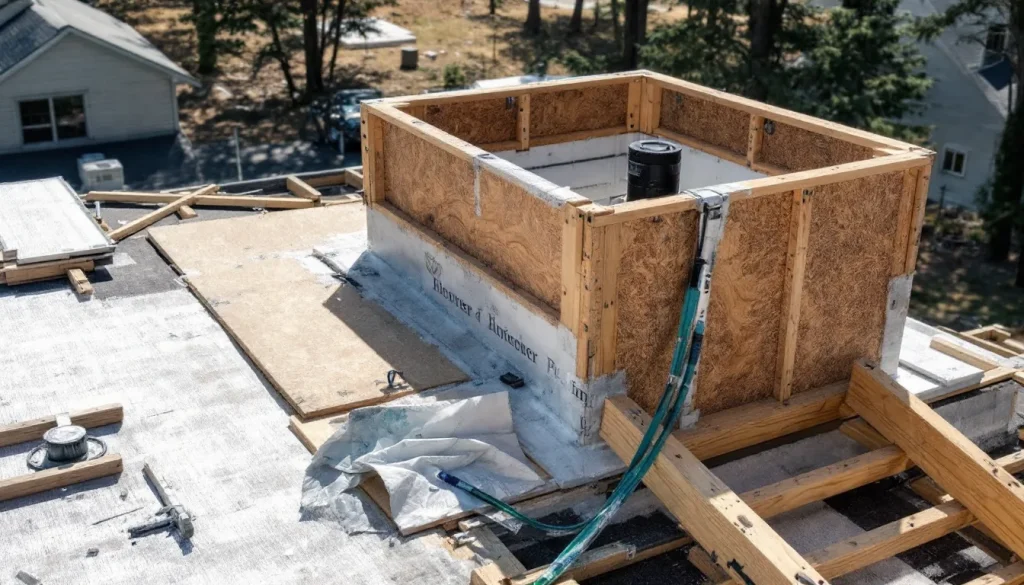
A roof saddle (see our roof cricket design) is a small framed ridge built on the uphill side of a chimney, dormer, or wall obstruction that diverts water around the obstruction instead of letting it pile against the wall and pond. It is the same thing as a cricket, just two names for one detail. The terminology split has confused homeowners and contractors for decades, but the IRC settles it: the same R1003.20 code section calls it a “cricket or saddle” and mandates it on the uphill side of any chimney wider than 30 inches measured perpendicular to the slope. Below 30 inches, a saddle is optional but still smart. The detail involves three layers: a framed peak (ridge board and two rafters), a sheathing skin, and a sequence of ice and water shield, metal flashing, and counter-flashing into a reglet cut in the chimney face.
The short version
- Saddle and cricket are the same thing: a small framed peak built uphill of a chimney to divert water around it.
- IRC R1003.20 mandates one on the uphill side of any chimney wider than 30 in (measured perpendicular to roof slope).
- Framing: ridge board centered on chimney width, two rafters at 4:12 to 6:12 slope, sheathing skin matching the deck.
- Waterproofing layer order: ice and water shield FIRST, then galvanized or copper sheet metal flashing, then counter-flashing reglet cut into the chimney.
- Use copper or 26-gauge galvanized for the flashing. Aluminum corrodes against masonry mortar.
- Cost: $400 to $1,200 installed on a typical residential chimney, depending on size and access.
Saddle and cricket are the same thing
Open any roofing trade publication, ask three different contractors, and you will get three different answers about the saddle-vs-cricket distinction. The truth is they are the same detail with two interchangeable names. Some sources will claim a saddle is bigger or built on more than just chimneys (around dormers, walls, parapets) while a cricket is specifically a chimney detail. The IRC does not honor that distinction. R1003.20 uses both terms in the same sentence.
What matters is the function: a small framed ridge built on the uphill side of any obstruction that disrupts roof water flow, so meltwater and runoff shed around the obstruction instead of pooling against it. Without a saddle, water hitting the uphill face of a 36-inch chimney runs down both sides and concentrates at the back corners, where it freezes, finds the flashing seam, and leaks. With a saddle, the water hits the saddle ridge, splits cleanly to either side, and never touches the chimney face.
When code requires a saddle
IRC R1003.20 (the chimney chapter): “Saddles or crickets shall be installed where the dimension parallel to the ridge of any chimney is greater than 30 inches.” Translated: measure the chimney face that is parallel to the roof ridge. If it is wider than 30 inches, a saddle is required. The dimension perpendicular to the ridge (the chimney depth) is not the trigger.
Why 30 inches? Below that width, the volume of water hitting the chimney face is small enough that step flashing and a properly installed apron flashing can shed it. Above 30 inches, the water volume overwhelms the apron and concentrates at the back corners, where the flashing details are weakest. A saddle moves the water around the chimney entirely.
Some local codes are stricter. California Building Code calls for a saddle on any chimney over 24 inches in snow regions. Florida Building Code and other hurricane codes require saddles on any chimney over 18 inches because wind-driven rain at the chimney face is the dominant water source. Check your AHJ. For chimneys below the trigger size, a saddle is still smart insurance: it costs $300 to $700 to add during a reroof and prevents the most common chimney leak in the industry.
Saddle framing detail
The framed saddle is a tiny dual-pitch roof. Three components:
- Ridge board: 2×4 or 2×6 running perpendicular to the main roof ridge, centered on the chimney width. Length equals the chimney width plus 12 to 24 inches on each side for the rafter projection.
- Rafters: Two rafters at 4:12 to 6:12 slope running from the saddle ridge down to the main roof deck. The rafters are tied into the chimney face at the high end (using metal saddle hangers) or rest on the existing deck (using rafter ties). Spaced 16 to 24 inches on center for the typical residential saddle width.
- Sheathing: 1/2 inch CDX plywood or 7/16 inch OSB, matched to the existing roof deck thickness. Cut to fit the saddle triangles and nail to the rafters with 8d common nails at 6 inches on center at panel edges and 12 inches in the field.
The saddle height (the peak height above the main roof deck) is typically 6 to 12 inches at the chimney face, tapering to zero at the downhill rafter end. The exact dimensions follow from chimney width and the desired saddle slope. A 36-inch wide chimney with a 6:12 saddle slope produces an 18-inch high peak at the chimney face if rafters extend 36 inches downhill. Higher peak equals more water diversion but more visual bulk on the roof.
Materials and sizing
| Component | Material | Size | Notes |
|---|---|---|---|
| Ridge board | Pressure-treated 2×4 or 2×6 | Width = chimney width + 12 to 24 in | PT required for contact with masonry |
| Rafters | SPF 2×4 or 2×6 | 4:12 to 6:12 slope, 16 to 24 in OC | Tie to chimney with saddle hangers OR rest on existing deck |
| Sheathing | 1/2 in CDX plywood or 7/16 in OSB | Cut to fit saddle triangles | Match existing deck thickness |
| Ice and water shield | 40-mil or 60-mil self-adhered | Full coverage of saddle + 12 in onto chimney + 18 in onto roof field | Grace, GAF StormGuard, CertainTeed WinterGuard |
| Sheet metal flashing | 26-gauge galvanized or 16-oz copper | Custom-bent to saddle profile | 6 in onto roof, 6 in up chimney face |
| Counter-flashing | Same metal as base flashing | Reglet cut 1.5 in deep into mortar joint | Bent down 4 in to overlap base flashing |
Install sequence (8 steps)
- Strip the area. Tear off shingles, underlayment, and existing flashing in a working zone extending 24 inches around the chimney on all sides. Expose the deck and any rafters under the saddle area. Verify deck is sound and replace any rotten sheathing.
- Frame the saddle. Measure chimney width parallel to ridge. Cut the ridge board to chimney width plus desired rafter projection on each side. Position the ridge board centered on the chimney width, touching the uphill face of the chimney, perpendicular to the main roof ridge. Install metal saddle hangers (Simpson H1 or similar) on the chimney face to support the high end of the ridge board, or use a ledger bolted to the chimney with masonry anchors. Cut and install two rafters per side, sloping from the ridge board down to the main roof deck. Nail with 16d common nails or use Simpson rafter ties.
- Sheath the saddle. Cut sheathing to fit each saddle triangle. Nail to the rafters with 8d common nails at 6 inches on center at panel edges. The sheathing surface should be flush with the existing roof deck where they meet so shingles lay flat across the transition.
- Ice and water shield over the entire saddle. Self-adhered membrane covers 100 percent of the saddle sheathing, extends 12 inches up the chimney face (bonded to the masonry), and extends 18 inches onto the surrounding roof field on all sides. This is the primary waterproofing layer. See the peel and stick underlayment guide for application detail on masonry.
- Form the base flashing. Cut 26-gauge galvanized or 16-oz copper sheet metal to a saddle pattern: a roughly diamond-shaped piece that has a 6-inch turn-up against the chimney face, a 6-inch lap onto the roof field on each side of the saddle, and seams along the saddle ridge bent to match the saddle slope. The metal piece is one continuous custom-bent pattern, NOT pieced together at seams. Order it from a sheet metal shop with the chimney dimensions and saddle slope; expect $80 to $200 in custom metal work.
- Install the base flashing. Set the base flashing over the ice and water shield. The bottom lap onto the roof field sits OVER the underlayment of the surrounding roof field. The chimney upturn is held against the chimney face with masonry anchors or polyurethane sealant. The saddle ridge seam folds over the saddle peak.
- Cut the reglet and install counter-flashing. A reglet is a horizontal groove cut into the mortar joint of the chimney, 1.5 inches deep, at a height that lets the counter-flashing drop down 4 inches to overlap the base flashing turn-up. Use a masonry saw or grinder. Cut the counter-flashing from the same metal as the base flashing, with a 1.5-inch lip that tucks into the reglet. Insert the lip, fill the reglet with polyurethane sealant, fold the counter-flashing down over the base flashing turn-up. The two layers of flashing now overlap by 2 inches.
- Shingle over the base flashing. Run new shingle courses across the saddle, with each course lapping the base flashing by the standard shingle exposure. Use step flashing in the corners where the saddle slope meets the main roof slope. The shingle courses cover the roof-field portion of the base flashing; only the chimney upturn and the counter-flashing remain visible.
Common mistakes
The chimney saddle is one of the highest-leak-risk details on any residential roof. The errors are mostly about layer order and material choice.
- No saddle on a 36-inch chimney. Skipping the saddle on a code-triggered chimney is the single most common mistake. The contractor saves an hour, the homeowner gets a leak in year 3.
- Aluminum flashing against masonry. Aluminum and lime mortar react: the mortar etches the aluminum and produces a chalky white corrosion that breaches the flashing within 5 to 10 years. Use copper or galvanized steel for any chimney flashing.
- Sealant instead of a reglet cut. Counter-flashing held to the chimney face with polyurethane sealant fails the first time the sealant cracks (3 to 7 years). The reglet cut mechanically locks the counter-flashing in place and the sealant only weatherproofs the joint. Cut the reglet.
- Pieced-together base flashing. Trying to piece the saddle base flashing from rectangular shingle flashing pieces leaves seams along the saddle ridge, exactly where water concentrates. Use a single custom-bent piece.
- Ice and water shield short of the chimney. The membrane needs to extend 12 inches UP the chimney face, bonded to the masonry. Stopping at the chimney base leaves the most vulnerable joint unprotected by the primary waterproofing layer.
- No saddle hangers at the ridge board. Toe-nailing the ridge board to the chimney face without metal hangers means the saddle is supported only by friction and a couple of nails. Snow load on the saddle pulls the connection apart over time.
- Step flashing tucked under the base flashing at the corners. The step flashing sequence should be: step flashing OVER base flashing on the chimney sides, so water from the saddle drains onto the step flashing, not behind it. Reverse the lap and the corners leak first.
- Cricket too shallow. A saddle with less than 4:12 slope produces a low peak that does not divert water effectively. Snow piles on it and creates an ice dam. Build at 6:12 or steeper.
- Pressure-treated lumber not used at the masonry contact. Standard SPF 2×4 against masonry wicks moisture and rots within 5 to 10 years. The ridge board and any rafter end touching masonry must be pressure-treated or copper-isolated.
- Failure to flash the counter-flashing termination. Where the counter-flashing meets the front and back of the chimney, the joint needs to be sealed and stepped. Open ends let wind-driven rain enter the reglet.
Cost
Material cost for a saddle on a typical 36-inch chimney:
- Framing lumber (PT 2×6 ridge, SPF 2×4 rafters): $40 to $80
- Sheathing (one sheet 7/16 OSB cut to size): $35
- Ice and water shield (one roll partial use): $40
- Custom-bent galvanized base flashing: $80 to $150
- Counter-flashing material: $40 to $80
- Polyurethane sealant, masonry anchors, fasteners: $30
- Replacement shingles (1 to 2 bundles): $40 to $80
Material total: $305 to $495.
Labor on a reroof, when the chimney is already accessible and the rest of the roof is being torn off, runs $200 to $400 for the saddle install. On a retrofit (existing roof staying, adding a saddle around an existing chimney), labor climbs to $400 to $800 because of the surrounding shingle work. Total installed cost: $500 to $1,200 retrofit, $400 to $900 during a reroof.
Saddle around other obstructions
The saddle/cricket detail is most associated with chimneys but applies to other roof obstructions too:
- Dormers wider than 30 in: The same detail applies on the uphill side of any dormer with a vertical face wider than 30 inches. Same framing, same flashing sequence.
- Skylights wider than 30 in: Code does not strictly require a cricket on a skylight, but on wider skylights (over 36 inches) one is best practice. See skylight leak repair for the related detail.
- Parapet walls or roof-to-wall transitions: Where a roof slope dies into a vertical wall and the wall is more than 30 inches wide, a saddle on the high side handles the water that would otherwise pond against the wall.
The same framing, sheathing, and flashing layer order applies in every case. See our broader cricket detail in chimney cricket install for the version specific to traditional chimneys.
FAQ
Is a saddle the same as a cricket? Yes. The IRC uses both terms interchangeably in R1003.20. Some sources try to distinguish them by size or location but there is no consistent industry definition. They are the same detail.
When is a saddle required by code? On the uphill side of any chimney wider than 30 inches measured parallel to the roof ridge. IRC R1003.20. Some local codes lower the threshold to 24 inches in snow regions or 18 inches in hurricane regions.
Can I install a saddle on an existing roof without tearing off shingles? Partially. You can frame and sheath the saddle, but the underlayment, base flashing, counter-flashing, and shingle replacement requires removing existing shingles in a working zone of 24 inches around the chimney. Plan it into a reroof or budget 6 to 12 hours of shingle work.
What slope should the saddle be? 4:12 minimum, 6:12 to 8:12 typical. Steeper sheds water and snow faster. Shallower is a sign someone is trying to save sheathing.
Why does my chimney leak even though it has a cricket? Usually because the cricket was framed correctly but the flashing detail was botched: aluminum against masonry, sealant instead of reglet, pieced flashing at the saddle ridge, or step flashing under base flashing in the corners. See the chimney flashing leak repair guide for the diagnostic checklist.
Bottom line
A roof saddle and a roof cricket are the same thing: a framed peak on the uphill side of a chimney or other obstruction that diverts water around it. Code requires one on chimneys wider than 30 inches and most local codes go further. The detail is framing plus sheathing plus three layers of waterproofing (ice and water shield, base flashing, counter-flashing into a reglet), built with copper or galvanized steel and pressure-treated lumber where it touches masonry. Done right, the saddle is invisible from the ground and bulletproof for the life of the roof. Skipped or botched, the chimney leaks in year 3 and the homeowner pays five times the cost to chase the leak instead of doing it right the first time.