
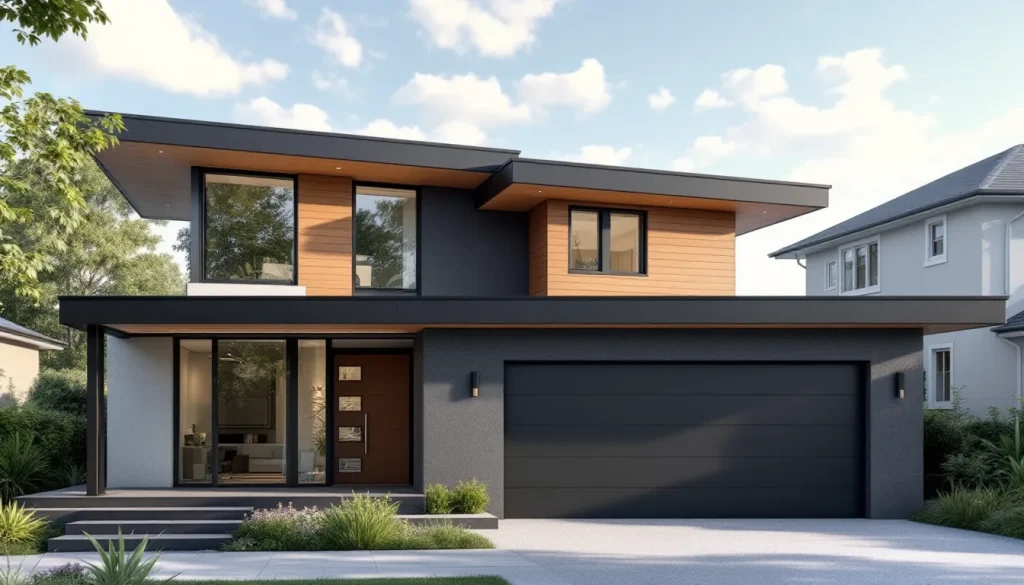
A residential flat roof is a low slope roof section on a house, typically over an addition, garage, porch, dormer, modern flat roof house design, or rowhouse extension, installed at less than 2:12 slope and usually waterproofed with EPDM, modified bitumen, or TPO membrane. Installed costs in 2026 run $5 to $9 per square foot for EPDM, $6 to $11 for modified bitumen, and $7 to $12 for TPO on residential applications. The single most important spec is positive slope to drains, scuppers, or gutters at 1/4 inch per foot minimum under IRC R905. The second most important is flashing detail where the flat section meets the adjacent sloped roof, parapet wall, or sidewall. Get those two right and a residential flat roof will deliver 20 to 30 years. Get them wrong and you will be patching leaks at year 5.
The short version
- EPDM is the residential flat roof favorite because it installs over wood deck without specialty welding equipment and ties cleanly into adjacent sloped roofs.
- Modified bitumen self adhered (GAF Liberty, Henry, IKO) is the smaller residential flat section workhorse, especially over porches, dormers, and small additions.
- TPO is gaining residential share but requires hot air welding equipment that smaller residential crews may not carry.
- IRC R905 mandates minimum 1/4 inch per foot slope on most low slope systems. Check the spec before you sign.
- The wall and sloped roof transitions are where residential flat roofs fail. Counter flashing, step flashing, and termination bars done right matter more than membrane brand.
- Drainage to gutters works for most residential flat roofs. Internal drains are rare on residential because of plumbing complexity.
Short answer: when a residential flat roof makes sense
Flat roofs show up on residential buildings in five common scenarios. Additions over garages, family rooms, or master suites where matching the existing roof line was impractical. Porches and entry roofs where the architecture calls for a clean horizontal line. Rowhouse and brownstone applications where structures share walls and the roof spans corner to corner. Modern and mid century architecture where flat roofs are part of the design intent. And dormer roofs on otherwise sloped roofs where the small flat section ties into the larger system.
Each scenario has different stakes. An addition with a flat roof needs to keep water out of a finished interior space, so leak performance is critical. A porch flat roof over an open porch is more forgiving because a small leak does not damage interior finishes. A modern home flat roof over the entire living space has the highest stakes. A rowhouse flat roof shares structural and waterproofing context with the neighboring buildings, which adds complications.
The good news is that the same five materials covered in flat roof types 2026 all work on residential applications. The choices narrow because residential crews carry different equipment than commercial crews, and the small roof areas typical of residential work do not justify the welder setup cost on TPO and PVC. EPDM and modified bitumen dominate residential flat roof work for these practical reasons.
The five residential flat roof scenarios at a glance
| Scenario | Typical area | Best material | Critical detail |
|---|---|---|---|
| Garage or addition with finished space below | 200 to 800 sq ft | EPDM 60 mil or modified bitumen 2 ply | Sidewall flashing where flat meets sloped main roof |
| Open porch or entry overhang | 50 to 200 sq ft | Modified bitumen self adhered or EPDM 60 mil | Wall counter flashing |
| Whole house modern architecture | 1,200 to 3,000 sq ft | TPO 60 mil or EPDM 60 mil fully adhered | Parapet wall transitions, internal drains if no slope |
| Rowhouse or brownstone | 800 to 1,500 sq ft | EPDM 60 mil or modified bitumen | Party wall flashing, shared drainage tie ins |
| Dormer flat top | 20 to 100 sq ft | Modified bitumen self adhered or EPDM | Step flashing to sloped roof on three sides |
EPDM: the residential favorite
EPDM is the most common residential flat roof material in 2026 because it installs cleanly over wood roof decks, ties into adjacent sloped roofs with simple termination details, and does not require specialty welding equipment. Most residential roofing crews carry EPDM materials and adhesives as standard inventory.
Residential EPDM typically goes down fully adhered with bonding adhesive over the deck and insulation. The membrane comes in 45 mil and 60 mil thicknesses, with 60 mil being the residential standard. Seams are sealed with factory cured seam tape, which has improved dramatically since the 1990s. Modern EPDM tape seams outlast the field membrane when installed correctly.
The major EPDM brands for residential work are Carlisle SynTec Sure Seal, Firestone (now Holcim) RubberGard, Versico VersiGard, Mule Hide EPDM, and Johns Manville EPDM. The brand choice matters less than the contractor’s familiarity with the product. A crew that installs Carlisle Sure Seal weekly will produce a better roof than a crew that switches brands every job.
Where EPDM wins on residential. Lower install cost ($5 to $9 per square foot installed), wide contractor availability, easy tie ins to adjacent sloped roofs, and proven long term performance. Where it loses. Black color absorbs heat (less of an issue on residential than commercial because residential flat areas are small), and tape seams require skilled install to perform.
For the EPDM versus TPO comparison in detail, see TPO vs EPDM roofing.
Modified bitumen: the small residential flat section workhorse
Modified bitumen self adhered is the dominant material for small residential flat roof sections like porches, dormer tops, small additions, and entry overhangs. The reason is that self adhered modified bitumen rolls directly over the substrate with a pressure sensitive adhesive backing, no torch, no hot asphalt, and no specialty equipment. A two person residential crew can install 200 square feet of self adhered modified bitumen in a morning.
The dominant residential brand is GAF Liberty, a self adhered SBS modified bitumen system available at most building supply distributors. Liberty installs in two plies: a self adhered base sheet followed by a mineral surfaced cap sheet (smooth or granular). The two ply construction provides redundancy that single ply systems lack on small residential roofs.
Other major residential modified bitumen brands are CertainTeed Flintastic, Henry HE925 series self adhered, IKO modified bitumen, and Polyglass self adhered systems. Soprema produces premium modified bitumen used on higher end residential and commercial work.
Where modified bitumen wins on small residential. No specialty equipment needed, two ply redundancy means a single ply puncture does not leak immediately, easy repair (peel and stick patches), and good tie ins to adjacent shingles. Where it loses. Shorter lifespan than single ply membrane (15 to 25 years versus 25 to 30), heavier than single ply membrane, and granule loss after 12 to 18 years requires recoat or replacement.
For the system in more detail, see modified bitumen roof.
TPO on residential: growing but specialized
TPO is the dominant commercial flat roof material, and its residential share is growing as crews adopt welding equipment for residential commercial hybrid work. A residential crew that does both commercial flat roofs and residential additions can spec TPO across both. A crew that only does residential shingle and EPDM typically does not carry the welder.
Where TPO wins on residential. White reflective surface reduces cooling load (useful in southern climates on whole house flat roofs), 60 mil thickness delivers 20 to 30 year lifespan, and welded seams are mechanically stronger than tape seams. Where it loses. Welding equipment requirement limits contractor pool, higher cost per square foot ($7 to $12 installed versus $5 to $9 for EPDM), and more complex tie ins to adjacent shingles than EPDM.
For whole house modern architecture homes with large flat roof areas in hot climates (Phoenix, Tucson, Las Vegas), white TPO is increasingly the spec. For small residential flat sections in mixed or cold climates, EPDM remains the favorite.
Slope: the IRC requirement and why it matters
IRC R905 mandates minimum slope requirements for residential low slope and flat roof systems. The thresholds: under 2:12 slope (less than 2 inches of rise per 12 inches of run) requires a low slope membrane system. Under 1:12 requires special detailing for some materials. Under 1/4 inch per foot (roughly 1:48) is generally not permitted for new construction under current code.
| Slope | System type | Acceptable materials |
|---|---|---|
| 2:12 or steeper | Steep slope | Shingles, metal, tile, slate |
| 1:12 to 2:12 | Low slope with steep slope materials | Modified bitumen, single ply, modified asphalt shingles with reinforced underlayment |
| 1/4 inch per foot to 1:12 | Low slope membrane | EPDM, TPO, PVC, modified bitumen, BUR |
| Under 1/4 inch per foot | Generally not permitted | Requires variance, tapered insulation, or design correction |
The 1/4 inch per foot slope is the baseline for any flat roof to drain. A roof at 1/8 inch per foot or completely flat will pond water, which voids warranty and accelerates membrane failure. If your existing residential flat roof is below the 1/4 inch threshold, the replacement spec should include tapered insulation to bring it into compliance. See flat roof drainage design for the tapered math.
The wall and sloped roof transitions: where residential flat roofs leak
The single most common failure point on residential flat roofs is the transition where the flat section meets either a vertical wall (the house wall, a parapet, or a chimney) or the adjacent sloped main roof. Ongoing flat roof maintenance of these joints keeps small failures from becoming leaks. Detail execution at this transition matters more than membrane material.
At a sidewall transition, the membrane must extend up the wall a minimum of 8 inches (some codes specify 12 inches) and terminate with a metal counter flashing inserted into a reglet cut into the wall or behind the wall siding. The membrane termination at the top must be sealed to prevent water entry behind. The vertical wall portion of the membrane must be securely attached to prevent shrinkage pulling it down over time. See counter flashing for the detail specifics.
At a sloped roof transition where a flat addition meets the main house sloped roof, the membrane must lap onto the sloped roof under the existing shingles or other roofing. This is typically done by lifting the bottom courses of shingles, extending the flat membrane 12 inches under, and re nailing the shingles over the membrane lap. Done right, this creates a watertight lap. Done wrong, water enters under the shingles and rots the deck. See roof flashing for the broader treatment.
At a parapet wall (common on rowhouses), the membrane must extend up the parapet, over the top, and terminate on the back side or under a coping. Parapet wall failures are the dominant residential flat roof leak source on urban and rowhouse construction. See parapet wall roofing detail for the full parapet treatment.
Drainage on residential flat roofs
Residential flat roofs typically drain three ways. To external gutters at the perimeter (the most common residential approach), through scuppers in a parapet wall (common on rowhouse and modern construction), or to internal drains through the deck (rare on residential due to plumbing complexity).
Gutter drainage works well on residential flat roofs that have positive slope to the gutter edge. The membrane terminates at the drip edge over the gutter, water sheds into the gutter, and the gutter conveys water to downspouts. The critical detail is that the membrane must extend onto the drip edge or fascia and seal to it to prevent water entry behind the gutter.
Scupper drainage works on residential flat roofs with parapet walls. Scuppers are openings through the parapet that let water drain to external downspouts or to splash pads at grade. Scupper sizing follows IPC requirements based on roof area and rainfall intensity. A residential scupper typically runs 4 inches wide by 6 to 8 inches tall, with two scuppers per drainage area for redundancy. See scuppers vs gutters flat roof for the detailed comparison.
Internal drains are rare on residential because they require plumbing penetrations through the roof and through the interior space. When they are used (typically on whole house modern architecture flat roofs), the drain assembly is a critical leak risk and must be installed with manufacturer detail compliance.
Cost per square foot on residential flat roofs
| Material | Small flat roof (under 500 sq ft) | Medium flat roof (500 to 1,500 sq ft) | Large flat roof (over 1,500 sq ft) |
|---|---|---|---|
| EPDM 60 mil | $8 to $14 | $6 to $10 | $5 to $9 |
| Modified bitumen 2 ply | $8 to $14 | $6 to $11 | $6 to $10 |
| TPO 60 mil | $10 to $16 | $8 to $13 | $7 to $12 |
| PVC 60 mil | $13 to $20 | $10 to $16 | $9 to $15 |
Residential flat roof work runs higher per square foot than commercial because of mobilization cost spread over smaller area. A 200 square foot porch flat roof might cost $2,800 to $3,200 total. The same membrane and labor spread over 20,000 commercial square feet would run $1.40 to $1.60 per square foot. For broader replacement pricing, see flat roof replacement cost. For the full new roof picture, see how much does a new roof cost.
Insulation: the layer that does the energy work
A residential flat roof must meet IECC insulation requirements like any other roof. IECC 2024 requires R 38 to R 49 in residential roofs depending on climate zone. For a flat roof, this is typically achieved with rigid polyiso insulation above the deck (typically 5 to 7 inches) or a combination of above deck rigid and below deck batt insulation.
The above deck approach is preferred for several reasons. The insulation is continuous and unbroken by framing members. The roof deck stays warm in winter, reducing risk of condensation. And tapered insulation can deliver both insulation and slope in a single layer. The downside is roof height, which can be visually noticeable on a residential addition.
The below deck approach uses batt or blown insulation between the rafters or trusses. This is the common approach on existing residential flat roofs being replaced without adding to roof height. R value is limited by the framing depth, and thermal bridging through the framing reduces overall assembly performance. Where below deck insulation is used, the assembly should include a continuous air barrier and vapor retarder to manage moisture.
Ventilation considerations
Residential sloped roofs use intake and exhaust ventilation to manage moisture and heat. Residential flat roofs typically cannot be ventilated the same way. This means the assembly must be designed as an unvented (hot roof) assembly with air sealing and vapor management built in.
The IRC R806.4 unvented attic assembly requirements apply. The roof assembly must include adequate insulation above and below the deck, a continuous air barrier on the warm side, and air impermeable insulation directly against the underside of the roof deck if the assembly is conditioned. Failing to detail this correctly leads to condensation inside the roof assembly, which rots the deck from below over 5 to 10 years.
This is one of the most common failure modes on residential flat roofs that look fine from above but are rotten from below. If you are seeing interior moisture stains, mold on ceilings, or sagging finishes on a residential flat roof addition, the cause may be condensation inside an undetailed unvented assembly, not a membrane leak.
Tie ins to existing shingles
Most residential flat roof additions tie into an existing sloped shingle roof at one or more edges. The transition detail determines whether the assembly leaks. The membrane (whether EPDM, modified bitumen, or TPO) must extend onto the shingle roof in a counterflashing lap that prevents water entry.
The standard detail. Lift the bottom three courses of shingles at the transition. Slide the flat roof membrane 12 inches up under the lifted shingles. Re nail the shingles through the membrane and into the deck with proper underlayment beneath. Seal the membrane to the underlayment with the manufacturer’s specified seam adhesive or seam tape.
The mistakes that fail. Membrane lap is too short (under 6 inches) and water blows under it. Shingles are not re nailed and lift in wind. Underlayment is not extended under the membrane and water enters the deck. The lap is sealed at the top with caulk only and the caulk fails at year 5. Each of these failure modes is preventable with proper detailing, and each one is what residential flat roof leak callbacks track to.
When to repair vs replace
| Age | Condition | Recommended action |
|---|---|---|
| Under 5 years | Isolated leaks at penetrations or transitions | Repair flashing or penetration, preserve warranty |
| 5 to 12 years | Membrane sound, leaks at transitions or seams | Repair targeted areas, plan replacement at 15 to 20 year mark |
| 12 to 18 years | Membrane weathered, multiple leak points | Coating restoration or partial replacement |
| 15 to 25 years | End of service life on most materials | Full tear off and replacement |
| Any age | Active ponding water over more than 25 percent of area | Tapered insulation retrofit or full replacement with proper slope |
For repair pricing in detail, see flat roof repair cost. For the coating restoration path, see flat roof coating restoration. For the broader signs that a roof needs replacement, see roof leak repair and how to fix a roof leak.
Lifespan expectations on residential flat roofs
| Material | Typical lifespan | With proper maintenance | Most common failure point |
|---|---|---|---|
| EPDM 60 mil fully adhered | 20 to 25 years | 25 to 30 years | Seam tape at field laps or wall flashing |
| Modified bitumen 2 ply | 15 to 22 years | 20 to 25 years | Cap sheet UV degradation and granule loss |
| TPO 60 mil | 20 to 25 years | 25 to 30 years | Seam welds and penetration flashing |
| PVC 60 mil | 22 to 27 years | 27 to 30 years | Seam welds and plasticizer migration (older formulations) |
| BUR (rare on residential) | 20 to 30 years | 30 plus years | Gravel displacement and surface erosion |
The lifespan ranges assume proper install, proper slope, and routine inspection. Add 5 years to the upper bound for annual inspection and minor maintenance. Subtract 5 to 10 years from the lower bound for ponding water or chronic leak conditions.
What residential flat roofs cost in 2026 by project type
| Project | Typical area | Total cost range |
|---|---|---|
| Small porch roof replacement | 100 to 200 sq ft | $1,200 to $3,500 |
| Garage flat roof replacement | 300 to 600 sq ft | $2,400 to $8,000 |
| Addition flat roof replacement | 400 to 1,000 sq ft | $3,000 to $14,000 |
| Whole house modern flat roof | 1,500 to 3,000 sq ft | $12,000 to $40,000 |
| Rowhouse or brownstone roof | 800 to 1,500 sq ft | $8,000 to $22,000 |
| Dormer flat top replacement | 20 to 100 sq ft | $500 to $1,800 |
FAQ
FAQs
Are residential flat roofs reliable?
Yes, when properly installed with adequate slope and well executed transitions to adjacent walls and sloped roofs. The historical reputation for leaking comes from older systems and poor detailing rather than the material itself. Modern EPDM, modified bitumen, and TPO all deliver 20 to 30 year service life on residential applications.
How long does a residential flat roof last?
EPDM and TPO deliver 20 to 30 years on residential applications. Modified bitumen runs 15 to 25 years. Maintenance (annual inspection, debris removal, prompt repair of small issues) adds 5 plus years to either end of the range.
Can I install a flat roof over my existing shingle roof on a low slope section?
If the slope is below 2:12, you should not have shingles on it at all (current IRC R905 prohibits asphalt shingles below 2:12 without modified underlayment). The right path is tear off the shingles and install a low slope membrane. Going membrane over shingles is not a code compliant assembly.
Do residential flat roofs need different insulation than sloped roofs?
Yes. Residential flat roofs typically use above deck rigid polyiso to deliver R 25 to R 38 of continuous insulation. The assembly must be designed as an unvented (hot roof) system with proper air sealing and vapor management. Sloped residential roofs typically use ventilated attic assemblies with batt or blown insulation at the ceiling level.
What is the best material for a residential flat roof?
EPDM 60 mil for most applications. Modified bitumen self adhered for small porches, dormers, and entry overhangs. TPO 60 mil for whole house modern architecture in hot climates. PVC only when chemical exposure requires it (rare on residential).
Does a residential flat roof leak more than a sloped roof?
Not if it is built right. The leak rate on a properly detailed residential flat roof is comparable to a properly detailed sloped roof. The reputation for leaking comes from older systems, inadequate slope, and poorly executed wall and sloped roof transitions. Build it right and it stays dry.
Bottom line
Residential flat roofs work well when built with proper slope (1/4 inch per foot minimum to drains, scuppers, or gutters), the right material for the application (EPDM for most, modified bitumen for small sections, TPO for whole house modern), and careful detailing at every wall, sloped roof, and parapet transition. EPDM 60 mil at $5 to $9 per square foot is the residential value pick. Modified bitumen self adhered is the small section workhorse. TPO is gaining residential share in hot climates and modern architecture. None of them work without proper slope and careful flashing. For pricing in detail, see flat roof replacement cost. For the material comparison, see flat roof materials compared. For the drainage that determines whether your roof lasts, see flat roof drainage design.
Related reading: all roofing guides | flat roof types 2026 | flat roof lifespan | TPO vs EPDM roofing | modified bitumen roof | ponding water flat roof | parapet wall roofing detail | roof flashing | counter flashing