
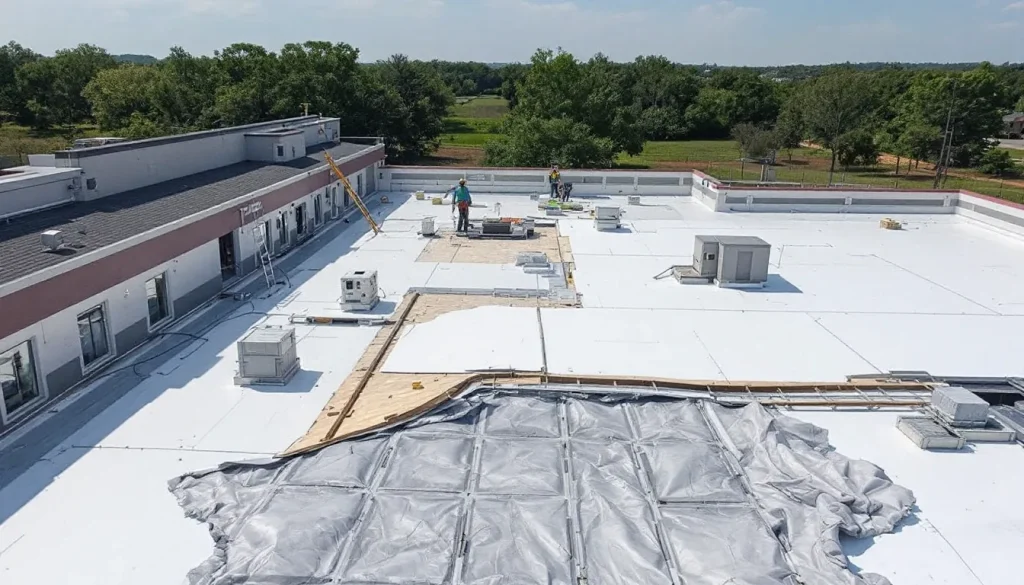
The commercial roof replacement cost (for the full data set, see our the full 2026 Roofing Cost Report) question gets a wide range of answers in 2026, and most of them are wrong. Online calculators throw out per-square-foot numbers that have no relationship to the actual specification, contractors guard their pricing, and building owners get caught between low-bid surprises and high-bid sticker shock. This guide breaks down what a commercial replacement actually costs in 2026, what is included in those numbers, what is excluded, and where the real variance comes from.
The honest per-square-foot ranges
Installed cost ranges per square foot in 2026 for the dominant commercial roofing systems (see our commercial roof types guide), including tear-off of one existing layer, R-25 polyiso insulation, 1/2 inch cover board, the listed membrane, fasteners, flashings, and standard parapet detail:
- TPO mechanically attached, 60 mil: $7-9 per square foot
- TPO fully adhered, 60 mil: $8-12 per square foot
- TPO ballasted, 60 mil: $5-8 per square foot
- EPDM mechanically attached, 60 mil: $6-8 per square foot
- EPDM fully adhered, 60 mil: $7-10 per square foot
- EPDM ballasted, 60 mil: $5-7 per square foot
- PVC fully adhered, 60 mil: $9-15 per square foot
- Modified bitumen, 2-ply SBS: $7-12 per square foot
- Standing seam metal, 24 gauge Galvalume: $14-22 per square foot
- Insulated metal panels (IMP), 5 inch PIR: $16-26 per square foot
A 20,000 square foot warehouse (see our industrial roof replacement guide) roof replaced with 60 mil mechanically attached TPO over R-25 polyiso in 2026 typically prices between $140,000 and $180,000 at the field rate, plus add-ons. A 100,000 square foot distribution center on the same spec lands $700,000 to $900,000 at the field rate. The variance is contractor margin, regional labor pricing, fastener spec required by wind zone, and details discussed below.
What the per-square-foot number actually includes
The honest line item for a commercial replacement covers the membrane, the insulation, the cover board, the fasteners (mechanical) or adhesive (adhered), the seam welding or bonding labor, and the flashing material at perimeters and penetrations. It also includes tear-off of one existing layer, dump fees for the removed material, and labor for the installation (see our commercial roof installation process guide) crew over the project duration.
The per-square-foot number does not include several real costs that show up as separate line items or change orders on the bid:
- Crane fees, material hoisting, and rooftop staging
- Tapered insulation for slope-to-drain (often $2-4 per square foot premium on roof area requiring slope)
- Additional layer tear-off beyond the first
- Decking repair or replacement (corroded steel, rotted wood, spalled concrete)
- New or upgraded drains, scuppers, gutters, downspouts
- Parapet cap replacement (typically $25-60 per linear foot in 2026)
- Curbs and flashings for new rooftop equipment
- Edge metal, drip edge, and termination bars at perimeters
- Lightning protection system re-bond or relocation
- HVAC disconnect and reset by certified mechanical contractor
- Permitting, structural review fees, engineering stamps
- Warranty registration fees (some manufacturers charge $200-2,000 depending on warranty term)
The realistic total project cost for a 50,000 square foot warehouse (see our industrial roofing systems guide) replacement with TPO mechanically attached comes in around $450,000-$600,000 once these add-ons are real numbers in the bid. The contractor who shows you $350,000 at $7 per square foot is either bidding on bare field installation or expecting to write change orders later. Read the exclusions on every bid.
System cost drivers, broken down
TPO mechanically attached, fully adhered, ballasted
Mechanically attached TPO is the cheapest install method because the fasteners and plates carry the wind load, the labor is fast (10,000+ square feet per day with a competent crew), and the prep work is minimal. The bid range of $7-9 per square foot reflects 60 mil membrane (see our commercial roofs overview by system) over R-25 polyiso with standard fastener pattern. Going to 80 mil membrane adds $0.50-1.00 per square foot. Going to higher wind zone fastener pattern (FM 1-120 instead of FM 1-90) adds $0.30-0.80 per square foot in additional fastener count.
Fully adhered TPO costs more because the adhesive (water-based or solvent-based) costs more per pound than fasteners cost (see our commercial roof restoration cost alternative) per box, and the labor is slower (crew has to wait for adhesive flash-off before rolling the membrane). The $8-12 range covers standard 60 mil over R-25 polyiso. Fully adhered is required where mechanical attachment cannot achieve the required uplift, where the deck does not accept fasteners (lightweight concrete, gypsum, structural cement-fiber deck), or where the building owner specifies it for aesthetic reasons.
Ballasted TPO is the cheapest of all because the ballast (river rock, pavers, or river-washed gravel at 10-15 pounds per square foot) holds the membrane down through gravity, and the seams are taped or welded. The $5-8 range covers it, but ballasted has fallen out of favor because the ballast adds significant dead load to the structure, makes leak detection nearly impossible (water travels under the ballast before showing inside), and creates fire-spread risk if the ballast shifts in high wind. Most 2026 specs avoid ballasted unless there is a specific structural reason to use it.
EPDM mechanically attached, fully adhered, ballasted
EPDM pricing tracks similarly to TPO but typically runs $0.50-1.50 lower per square foot at the membrane level. EPDM rolls come in larger widths (typically 10, 20, or 50 feet), which means fewer seams and faster install on simple geometries. Seam tape and seam adhesive have improved enough that modern EPDM seams rival heat-welded TPO seams in field performance, though manufacturers still spec (see our new construction commercial roof) longer warranty windows on TPO heat-welded seams.
The right time to specify EPDM over TPO: hail-prone regions (EPDM is more puncture-resistant than 60 mil TPO), simple roof geometries with few penetrations (fewer seams to fail), and budget-constrained replacements where the 25-year track record outweighs the reflectivity premium. The right time to specify TPO over EPDM: hot climates where white reflectivity reduces cooling load, complex roof geometries with many penetrations (heat-welded seams are easier to flash around obstacles), and high-traffic roofs where the membrane is going to take abuse.
PVC fully adhered
PVC pricing of $9-15 per square foot reflects 60 mil membrane fully adhered over R-25 polyiso. The premium over TPO is the chemical resistance, fire performance, and the longer warranty track record on the Sika Sarnafil brand specifically. PVC is the right specification for restaurants, hospitals, food processing, and any building with chemical or biological exposure. The bid premium is real, and on a 50,000 square foot project it can add $100,000-$200,000 over a TPO equivalent. That is the cost of buying chemical resistance and the longer service track record.
Modified bitumen, 2-ply SBS or APP
Modified bitumen pricing of $7-12 per square foot reflects a 2-ply SBS system: a base sheet and a cap sheet, both adhered, with optional granulated cap surface for fire rating and reflectivity. Mod-bit costs more than mechanically attached TPO because the install is more labor-intensive (torch-applied or cold-applied, both slower than TPO welding), and the material cost per square foot is higher.
The right time to specify mod-bit: steep-slope flat roofs (mod-bit handles thermal cycling on south-facing slopes better than TPO), heavy traffic roofs where puncture resistance matters, cold-climate installs where single-ply systems struggle with cold-weather application, and historic buildings where the appearance of granulated cap sheet matters.
Standing seam metal and IMP
Standing seam metal at $14-22 per square foot covers 24 gauge Galvalume or Kynar-finished steel panels, integrated with R-30 polyiso underlayment over the deck. The premium reflects panel material cost, factory finish, and slower install (longer panels, more cutting, more flashing detail at penetrations).
Insulated metal panels at $16-26 per square foot reflect the factory-laminated assembly with steel skins and PIR foam core. IMP is the dominant cold storage spec but is also used on manufacturing facilities where the combination of thermal performance, fire rating, and panel-as-finished-ceiling matters. Background on the metal options is in commercial metal roof and standing seam metal roof cost.
Where the variance comes from
Two contractors bidding the same roof can come in $1.50 per square foot apart, which on 50,000 square feet is $75,000. The variance is real and usually comes from one of the following:
Insulation thickness. R-25 polyiso versus R-30 polyiso is a $0.50-0.80 per square foot difference. Some bids quietly default to R-20 to hit a lower number. R-20 does not meet 2024 IECC code in most climate zones and will not pass inspection.
Membrane thickness. 45 mil versus 60 mil versus 80 mil TPO is each step $0.30-0.50 per square foot. The 45 mil membranes carry shorter warranties (typically 10-15 years) and lose to 60 mil and 80 mil on long-term puncture resistance.
Fastener density and pattern. Wind zone calculations under ASCE 7 and FM Global drive fastener spacing on mechanically attached systems. Hurricane zones can double the fastener count versus inland buildings. A contractor (see our commercial roofing contractors) bidding the same fastener density on a Miami project as an Indianapolis project is wrong, and the engineering review will catch it.
Cover board. 1/4 inch Securock versus 1/2 inch Securock versus no cover board is a real spec difference. No cover board saves $0.40-0.70 per square foot and trashes the long-term puncture resistance. Skip it at your own risk.
Tear-off depth. One layer tear-off versus full tear-off to deck is a $1.00-2.50 per square foot difference. Some bids assume one layer when there are actually two or three layers on the existing roof, which means the contractor finds extra material during the project and issues a change order.
Edge metal and flashings. Premium edge metal (24 gauge Kynar-finished) versus basic edge metal (mill-finish aluminum) is a $5-25 per linear foot difference. On a building with 1,000 linear feet of perimeter, that is $5,000-25,000. Specifications should call out the edge metal grade.
Crane and material handling. A 4-story building requires a crane. A 1-story building does not. Crane day-rates run $1,500-4,500 plus operator depending on size and reach. A project requiring 5 crane days is $7,500-22,500 above a project with no crane needs.
Building size effects
Per-square-foot pricing decreases as building size increases, up to about 100,000 square feet. The reason is mobilization, dumpsters, project management, and supervision are largely fixed costs on a project, so spreading them across more square feet brings the average down. A 5,000 square foot replacement at $12 per square foot may price the same per square foot as a 100,000 square foot replacement at $7.50 per square foot, because the fixed costs are a much larger share of the small project.
Above 100,000 square feet, the curve flattens. The materials cost per square foot is what it is, the labor productivity stops improving, and the project duration starts driving carrying costs (equipment, supervision, temporary weather protection). A 500,000 square foot replacement does not price meaningfully better per square foot than a 200,000 square foot replacement on the same spec.
Repair versus replacement decision
The classic decision rule: if the repair cost exceeds 30-40% of replacement cost, replace. The reason is repaired sections of an aging membrane fail again within 2-4 years, and the building owner ends up paying for repair plus replacement within a 5-year window. That decision math is laid out in detail in commercial roof repair guide and the alternative of recoating in commercial roof restoration.
The exception: an isolated puncture or seam failure on a roof less than 10 years into its service life is almost always a repair, not a replacement. Strategic repair extends life to 20-25 years. Strategic neglect (repair everything until the whole roof fails) ends with an emergency (see our 24/7 emergency commercial roof service) replacement at peak pricing.
The bid-rigging tells
Commercial roofing has a long history of competitive bid manipulation, mostly at the public-procurement level but also in private commercial work. The classic tells:
Three bids that are clustered within 1-2% of each other on a project with multiple contractors invited suggests bid-rigging. Real competitive bids vary by 8-20% even on tight specs because labor costs, supplier relationships, and contractor margins vary.
A single contractor bid that is 25-40% below the cluster of other bids suggests either a desperation bid (contractor needs the work to make payroll) or an intentional underbid setting up change orders later. Neither outcome is good.
A late-arriving bid that hits exactly between two existing bids suggests a tagalong contractor coordinating with one of the others. Reject it.
The fix is to invite at least four pre-qualified bidders, require sealed bids opened on a published date, and verify all credentials before bid invitation. Pre-qualification is detailed in commercial roofing contractor guide.
Storm damage and insurance
If the replacement is driven by hail, wind, or other insured peril, the insurance proceeds typically cover replacement-cost less depreciation, less deductible. On commercial policies, depreciation can be substantial on a roof more than 10 years into service life. Building owners frequently learn during a claim that they have actual cash value (ACV) coverage rather than replacement cost value (RCV) coverage, which can reduce a claim payout by 30-60%. Review the policy before the storm, not after. Detail on insurance claim mechanics is in commercial roof storm damage.
Financing options
For replacements that fall outside an insurance event, commercial owners have several financing paths: traditional commercial loans (5-7% rates in 2026 for credit-strong borrowers), Property Assessed Clean Energy (PACE) financing (which attaches the cost to property tax assessments for energy-efficient improvements), manufacturer-affiliated financing (some membrane manufacturers partner with finance companies for project loans), and leasing (less common but available). Each path has different terms and tax treatments. Comparison is in commercial roof financing.
What a full replacement bid should look like
A complete commercial replacement bid in 2026 should include:
- Total contract price, broken into mobilization, tear-off, insulation, membrane, flashings, edge metal, equipment curbs, drains, and warranty registration
- Specification by reference (manufacturer system specification sheet attached as exhibit)
- Schedule with milestones and weather-tight dates
- Payment terms (10% deposit, progress payments, 10% retention)
- Insurance certificates as exhibits
- Manufacturer certification proof as exhibits
- Warranty terms (NDL vs material, term, exclusions)
- Change order procedure
- Itemized allowances for unknown conditions (typically deck repair allowance of $5,000-25,000)
- Punch list and substantial completion criteria
Bid documents missing any of these are incomplete. Bid documents containing all of these are comparable across contractors. Our roofing estimate template walks through each line item.
2026 cost outlook
Material costs in commercial roofing in 2026 are roughly flat to slightly up versus 2025. TPO and EPDM resin prices have stabilized after the 2021-2023 inflation cycle. Insulation prices on polyiso are up 3-6% year over year. Labor costs continue to climb 5-8% annually as the qualified commercial roofing crews remain undersupplied versus demand. The net effect is most building owners are seeing 4-7% year-over-year increases on like-for-like replacement specs. Planning a replacement 12-18 months out and locking pricing through a pre-qualified contractor relationship is the standard playbook to manage that inflation.
The bottom line
A commercial roof replacement in 2026 prices between $5 per square foot (ballasted EPDM) and $26 per square foot (IMP cold storage), with the bulk of warehouse and manufacturing replacements landing $7-12 per square foot. The variance within those ranges is driven by spec details, building geometry, regional labor rates, and contractor margin. Read the bid for inclusions, exclusions, fastener density, membrane thickness, insulation R-value, and cover board. Compare bids on like-for-like specifications, not raw totals. And budget 10-15% above the field rate for the inevitable add-ons that show up during the project. The owners who get burned on commercial replacements are not the ones who paid too much. They are the ones who chose the lowest bid without reading what was missing from it.