
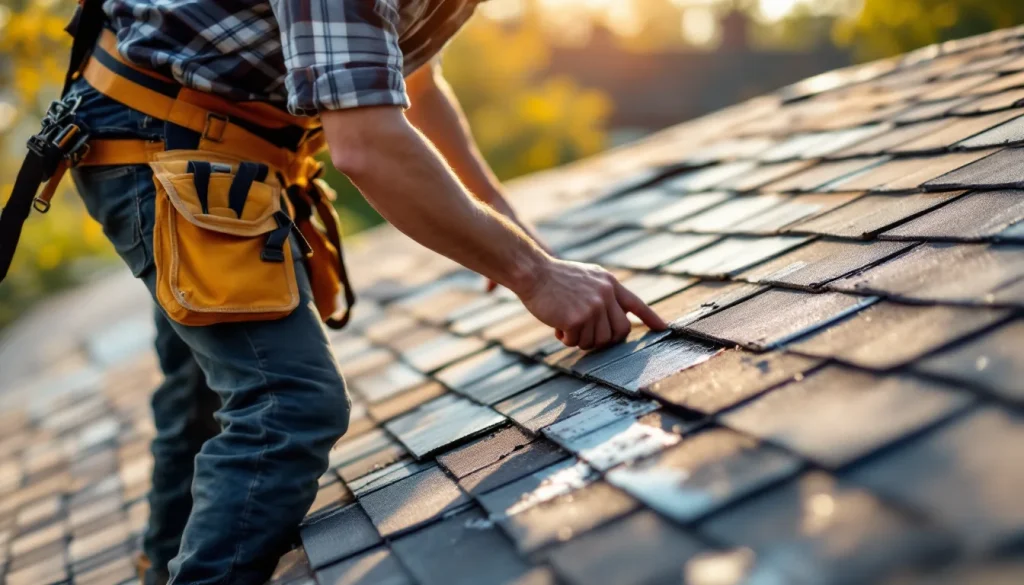
Roof repair (see our how much to repair a roof) costs in 2026 run from $150 for a simple pipe boot swap to $8,000+ for a full slope replacement on a complex residential roof, with the median small-to-medium repair landing between $400 and $1,400. The range is wide because “roof repair” covers everything from a single missing shingle tab to ripping a 20-ft valley back to the decking and rebuilding it with ice and water shield, new metal, and color-matched shingles. What separates a $300 fix from a $3,000 fix is rarely what the homeowner can see from the ground. It is the condition of the decking under the damage, the length and complexity of the affected detail, and whether the roofer has to touch flashing, fascia, or interior drywall to finish the job. Below is the itemized breakdown of 2026 repair pricing by problem type, with the cost drivers, the typical add-ons, and the threshold where repair stops making sense and full replacement takes over.
Last reviewed: August 2026.
The short version
- Leak patch (small, single source): $150 to $500. Trip charge sets the floor.
- Pipe boot replacement: $150 to $450 per boot. Most common single leak source on homes over 8 years old.
- Flashing repair (step, wall, drip edge): $400 to $1,200. Chimney flashing rebuild $400 to $2,500.
- Valley repair: $600 to $2,200 depending on length, open vs closed cut, and decking condition.
- Decking patch (one 4×8 sheet): $800 to $3,000 once you factor shingle removal, ice and water, and reshingling.
- Full slope replacement (one side of a typical roof): $2,500 to $8,000.
- Trip charge floor in 2026: $250 to $450 just to get a licensed, insured truck on the driveway.
- Rule of thumb: if repair is more than 30% of replacement cost, replace.
The short answer: roof repair pricing splits into four tiers
Roof repair costs in 2026 break into four pricing tiers, and where a job lands depends almost entirely on how deep the damage goes. Tier one is cosmetic and minor: a single missing shingle, a popped nail, a torn ridge cap. These run $150 to $500 and are mostly trip-charge driven. Tier two is functional: leak patches, pipe boot swaps, flashing rebuilds, small valley work. These run $400 to $2,200 and depend on how many details the roofer has to touch. Tier three is structural: decking patches, multi-sheet plywood replacement, fascia and soffit involvement. These run $1,500 to $5,000 and often signal that a full replacement is within sight. Tier four is full slope or sectional replacement, which runs $2,500 to $8,000 and is the gray zone between repair and full re-roof.
2026 itemized repair pricing: 18 common problems
The itemized 2026 pricing below spans 18 common residential repairs, from a $150 pipe boot swap to an $8,000 full slope replacement. Simple penetration and cosmetic fixes sit at the low end, flashing and valley work in the middle, and decking, structural, and slope-level jobs at the top. The table lists each repair, its typical 2026 cost range, and the factor that pushes it toward the high end of that range.
| Repair | Typical 2026 cost | What pushes the high end |
|---|---|---|
| Single missing shingle replaced | $200 to $500 | Trip charge, color matching, steep pitch |
| Small leak patch (under 4 sq ft) | $150 to $500 | Decking condition, access, multi-trip diagnosis |
| Pipe boot replacement (per boot) | $150 to $450 | Lead boot upgrade, multiple boots, steep pitch |
| Vent boot replacement | $150 to $450 | Multiple penetrations, boot style |
| Ridge cap shingle repair | $300 to $700 | Length of ridge, color match |
| Flashing repair (step or wall) | $400 to $1,200 | Siding involvement, length |
| Chimney flashing rebuild | $400 to $2,500 | Masonry counterflashing, chimney height, lead vs aluminum |
| Skylight flashing repair | $400 to $1,200 | Skylight age, curb rot |
| Skylight replacement and reflash | $1,200 to $3,500 | Size, glazing, interior finish |
| Drip edge replacement (one side) | $200 to $700 | Length, fascia rot, gutter R&R |
| Valley repair (open metal) | $600 to $2,200 | Length, decking, ice and water |
| Valley repair (closed cut) | $500 to $1,800 | Length, shingle matching |
| Decking patch (one 4×8 sheet) | $800 to $3,000 | Shingle removal, ice and water layer |
| Decking patch (multiple sheets) | $1,500 to $5,000 | Extent of rot, framing damage |
| Soffit and fascia repair | $400 to $1,800 | Aluminum vs wood, paint, gutter R&R |
| Ice dam damage repair | $800 to $4,000 | Decking, insulation, interior drywall |
| Full slope replacement (one side) | $2,500 to $8,000 | Pitch, complexity, decking condition |
| Sagging roof structural repair | $1,500 to $7,000 | Truss or rafter involvement |
These ranges are 2026 pricing pulled from working residential contractors in the Midwest, Southeast, and Mountain West markets. Coastal metros (Boston, NYC, Bay Area, Seattle, LA, Miami) run 25% to 40% higher across every line. Rural markets run 10% to 20% lower but trip charges rise because the truck is rolling further. The numbers assume a single-story or two-story home with walkable pitch (6/12 to 8/12). Anything steeper than 9/12 adds 15% to 30% in labor.
Trip charges: why every repair has a floor
Most insured, licensed residential roofers in 2026 will not roll a truck for less than $250 to $450. That floor pays for the driver, the lost time, the fuel, the general liability and workers comp premiums, and the warranty risk on any work they touch. A single missing shingle that takes 12 minutes to replace will still cost you $250 because that is what it costs the contractor to be there. Homeowners often misread this as gouging. It is not. It is the cost of keeping an insured crew operational. If a roofer quotes you $79 to “come look at it,” they are either coming out to upsell a full replacement or they are uninsured. Our guide on how to choose a roofing contractor covers the rest of the vetting checklist.
Leak patches: where most repair calls actually start
The single most common roof repair call in 2026 is “I have a leak,” and about 70% of residential leaks have nothing to do with the field of shingles. The leak is at a penetration (pipe boot, vent, skylight), a flashing detail (chimney, wall, step), a valley, or the drip edge. Diagnosis is half the cost, because a reputable roofer will spend 30 to 90 minutes on the roof and in the attic before quoting since the wrong fix will not stop the water. Our how to fix a roof leak playbook walks through the diagnosis sequence, and the roof leak repair guide covers the contractor pricing side.
Typical leak repair scenarios in 2026
- Pipe boot leak (rubber gasket cracked): $150 to $450 for the boot, plus access cost. Most common single leak source on homes 8+ years old. A lead boot upgrade runs another $50 to $120 in material.
- Step flashing leak at a wall: $400 to $1,200. Roofer has to lift siding to seat new flashing properly. If the siding is brittle vinyl or cement board with no spare pieces, expect a siding contractor involved.
- Chimney flashing leak: $400 to $2,500. Soft cost driver is whether the masonry counterflashing has to be cut into fresh mortar joints. Mason involvement doubles the bill.
- Skylight leak: $400 to $1,200 for a reflash. If the skylight itself is the leak source (failed seal, cracked glazing) and it is more than 15 years old, replacement at $1,200 to $3,500 is the right move.
- Field shingle leak (rare, under 30% of calls): $200 to $800 depending on how many tabs are damaged and decking condition underneath.
Vent boot and flashing replacement: the highest-ROI repairs
Pipe boots and vent boots are the highest-return repair on any residential roof. They are cheap (under $25 in material), they age fast (the rubber gasket cracks at 8 to 12 years even on a roof that otherwise looks fine), and a single failed boot can drop water into the attic for months before the homeowner notices a ceiling stain. In 2026 a vent boot replacement runs $150 to $450 per boot installed. If the roofer is already on the roof for another repair, additional boots in the same trip add only $75 to $150 each. A proactive homeowner with a 15-year-old roof should ask any roofer doing other work to swap every boot on the roof at the same time. It is the single best dollar spent on roof maintenance.
Flashing repair pricing tracks with linear footage and detail count. Step flashing (small L-shaped pieces under each shingle course where the roof meets a wall) runs $400 to $1,200 to replace a 10 to 15 ft section. Drip edge replacement (the metal L at the eave) runs $200 to $700 per side and frequently requires removing the first course of shingles and the gutter to install correctly. Wall flashing rebuilds where a roof meets a vertical sidewall are similar in price to step flashing and follow the same labor pattern. Our roof flashing repair guide goes deeper on the diagnostic side.
Valley repair: where small damage gets expensive fast
Valley repair in 2026 runs $600 to $2,200 for a typical 10 to 20 ft run. Valleys, where two roof slopes meet at an inside angle, channel a huge volume of water and are the single highest-stress area of any roof, and they concentrate ice dam pressure in cold climates. The cost driver is whether the roofer can patch in place or has to tear back 3 to 5 ft of shingles on each side, replace the metal or weave underneath, and reinstall. Open metal valleys (visible W-shaped metal channel) are easier to repair than closed cut valleys (shingles overlap the valley and are cut along a centerline) because the metal can be slid out without removing shingles. Closed cut valley repair almost always means tearing back shingle courses.
If the valley shows decking damage underneath (soft plywood, black staining, visible rot), add $400 to $1,500 in decking work and ice and water shield. A valley repair that turns into a decking job mid-project is one of the most common scope-blow scenarios in residential repair. A good contract spells out the per-sheet decking replacement rate up front so the homeowner knows what is coming.
Decking patches: when the plywood goes soft
Decking patch pricing in 2026 runs $800 to $3,000 for a single 4×8 sheet of plywood or OSB replaced, and $1,500 to $5,000 for multi-sheet jobs. The wide range is because decking work is never just decking. The roofer has to strip shingles in a 6 to 8 ft radius around the bad section, pull the underlayment, cut out the bad sheet, replace it, lay fresh ice and water shield or synthetic underlayment, then reshingle with color-matched material. Color match on a roof more than 5 years old is rarely perfect, and the patch will be visible from the street.
Decking damage usually has a root cause: a long-running leak, ice dam saturation, or under-ventilated attic. A repair contractor who replaces decking without diagnosing the cause is setting the homeowner up for the same problem in 3 to 5 years. Our roof deck repair cost guide walks through the diagnosis side, and cost to redo roof covers the math on when decking damage tips the project toward full replacement.
Full slope replacement: the gray zone between repair and re-roof
A full slope replacement (re-doing one side of a typical roof while leaving the other slopes in place) runs $2,500 to $8,000 in 2026 for a single-story home with walkable pitch. This is the gray zone where homeowners and contractors disagree most. Insurance adjusters will sometimes approve a single slope on a hail or wind claim. Contractors prefer to do the whole roof at once because tying new shingles into old at the ridge creates a visible color line and a warranty caveat from the shingle manufacturer. Most asphalt shingle warranties require full-roof installation to maintain material coverage.
The math on slope-only replacement: if the affected slope is 30% or more of the total roof area, and the unaffected slopes are within 5 years of the affected slope in age, full replacement is usually the better decision. The labor savings on doing the whole roof at once typically offset most of the additional shingle cost. A homeowner saving $4,000 by replacing only the south slope but creating a future tear-off cost of $3,500 to remove the remaining slopes a few years later is not actually saving anything. Single slope roof replacement covers the decision matrix in more detail.
When repair stops making sense: the 30% rule
The standard rule among residential roofers in 2026 is the 30% rule: if a single repair quote exceeds 30% of the full replacement cost, the homeowner should get a replacement quote before committing to the repair. On a 2,000 sq ft asphalt roof with a $14,000 replacement cost, that threshold is $4,200. A $1,800 valley repair on the same roof is clearly a repair decision. A $5,500 decking-and-valley-and-flashing combined quote is in 30%-rule territory and deserves a full replacement quote for comparison. Our 2026 Roofing Cost Report has the full dataset on replacement pricing by region, material, and pitch.
The other repair-vs-replace trigger is roof age. A 22-year-old asphalt roof with a $1,200 leak repair is not worth fixing in most cases because another leak is 18 months away. A 6-year-old roof with the same $1,200 repair is a clear repair decision because the rest of the roof has another 15 to 20 years of life. The break-even point on most architectural asphalt roofs in 2026 is around 18 years old: repairs under 20% of replacement cost still pencil, repairs over 25% almost never do.
Regional pricing: where 2026 repair costs deviate
Repair pricing deviates from the national median by region in 2026 in predictable patterns. The Northeast (Boston, NYC, NJ, eastern PA) runs 30% to 45% above median driven by union labor, dump fees, and parking and access logistics. The West Coast (Bay Area, LA, Seattle, Portland) runs 25% to 40% above driven by labor cost and code-mandated material upgrades. The Mountain West (Denver, SLC, Phoenix) runs near median. The Midwest (Chicago, Indianapolis, Columbus, Minneapolis) runs at or slightly below median. The Southeast (Atlanta, Nashville, Charlotte, Tampa) runs at median but with hurricane and hail surge pricing during claim season that can double standard repair rates for 6 to 10 weeks at a time.
Hurricane and hail surge pricing is the largest single regional variable. After a major hail event in Texas, Colorado, or the Midwest, repair rates can spike 40% to 80% above standard for 60 to 90 days as contractors prioritize insurance work over cash repairs. Homeowners with non-storm-related repairs in a surge market should either wait or pay the premium. Our roofing scams coverage gets into the storm-chaser side of post-event pricing, and roof repair cost guide has the full regional breakdown.
What insurance covers and what it does not in 2026
Homeowner insurance in 2026 covers sudden, accidental damage: hail, wind, fallen tree, lightning. It does not cover wear, age, deferred maintenance, or manufacturing defect. A boot that cracked from sun exposure at year 10 is not a claim. A boot that was torn loose by a tornado is. Carriers in 2026 are aggressively denying borderline claims and applying actual cash value depreciation on roofs over 10 years old in many states (FL, TX, OK, NC, GA, LA), meaning the payout is the depreciated value of the damaged section, not the cost to replace. Homeowners filing claims on 12+ year-old roofs in these states should expect 40% to 70% of the contractor estimate.
The right repair workflow with an active claim: get the contractor estimate first, file the claim with the contractor estimate attached, let the adjuster inspect, then negotiate. Contractors who handle claims regularly (most repair-and-replace shops in storm states) will work the supplements directly with the carrier. A homeowner filing alone almost always leaves money on the table because the adjuster will not voluntarily price line items the contractor has not flagged. 2026 Roofing Cost Report covers the claim trend data in depth.
How to read a repair estimate and not get burned
A legitimate 2026 repair estimate has six elements: scope of work in plain language, materials list with quantity and brand, labor as a separate line, decking allowance with a per-sheet rate for overage, warranty terms on the labor (1 to 5 years typical), and a payment schedule that does not require more than 30% up front. Anything missing one of these is either a shop that has not thought through the job or a shop that is leaving ambiguity to pad the final invoice. Homeowners should ask for a written scope before paying anything and should never pay 100% up front on a residential repair.
Photos are the other thing to ask for. A repair shop that cannot show before-and-after photos of the work has not been on the roof in the right way. Most 2026 residential repair shops shoot phone-camera photos as standard documentation, and homeowners should ask for the link to the photo set on completion. The photos also matter at resale: a buyer’s inspector who can see documentation of past repairs treats the roof differently than one who finds patches with no paper trail.
FAQ: roof repair costs in 2026
What is the cheapest roof repair in 2026?
The cheapest legitimate repair is a single shingle replacement or a vent boot swap on a roof the contractor is already on for other work. Standalone, both run $150 to $500 because of the trip charge floor. Bundled into a larger repair or roof tune-up, the per-item cost drops to $50 to $150. The annual roof tune-up (annual roof tune-up cost) at $300 to $750 is the cheapest way to bundle small repairs.
Can I repair my roof myself in 2026?
For minor cosmetic repairs (a single missing shingle on a low-pitch roof a homeowner can safely access with a ladder and a harness), yes. For anything involving flashing, valleys, decking, or leaks of unknown source, no. The risk is twofold: fall injury, and creating a worse leak that voids insurance coverage on the eventual claim. Most contractor liability insurance and homeowner policies have language excluding damage caused by amateur repair attempts. A $300 DIY repair that creates a $4,000 ceiling drywall claim is a bad trade.
How do I tell if a roof repair quote is fair in 2026?
Get three quotes, compare line by line, and look for the median. The lowest quote is rarely the best because it usually skips something (decking allowance, ice and water shield, proper flashing). The highest quote is sometimes legitimate if the contractor saw something the others missed, but more often is a margin play. The median quote from a contractor with verifiable insurance, written warranty, and references is the usual right answer. Our how to choose a roofing contractor guide has the full vetting checklist.
Does roof age affect repair cost?
Yes, in two directions. Older roofs cost slightly more to repair because color match is harder (shingles weather and current production runs do not match 15-year-old colors), and because old shingles tear and crumble when lifted to access flashing or decking. They also push the repair-vs-replace decision earlier because the rest of the roof is closer to end of life. A 6-year-old roof gets a $1,500 valley repair. A 22-year-old roof gets a full replacement quote.
What is the most expensive roof repair short of replacement?
Multi-sheet decking replacement combined with structural framing repair on a sagging roof. This can hit $7,000 to $12,000 on a residential roof before any shingle work is started and is the threshold where most contractors will steer the homeowner toward partial or full re-roof to amortize the labor across a longer-lasting result.