
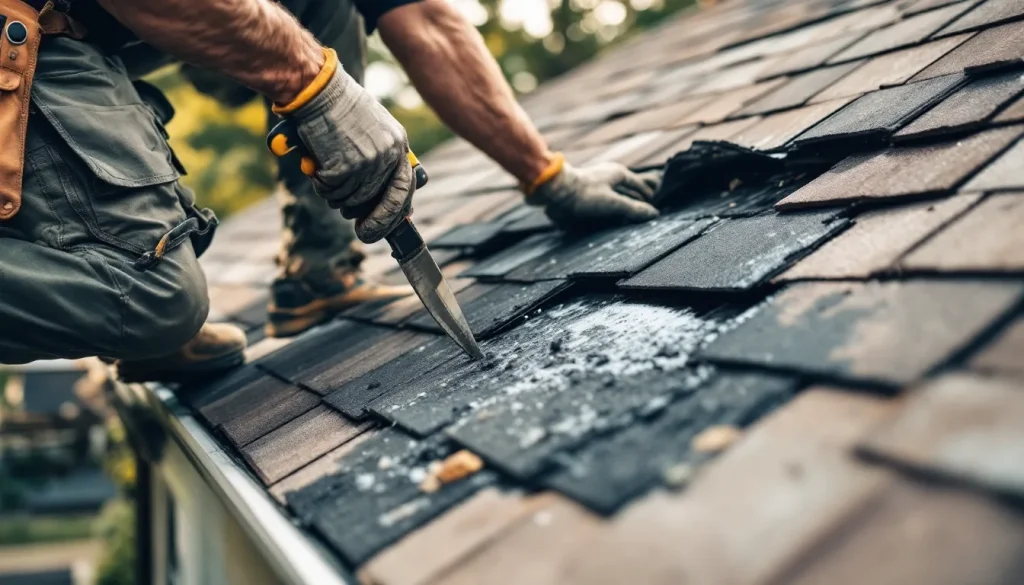
The answer to how much to repair a roof in 2026 lands between $150 for a single lifted shingle resealed during a service call and $4,000 for storm tree-limb damage that takes out decking, underlayment, and flashing in one shot. The honest median, the kind of repair most homeowners actually call about, runs $450 to $1,100: a leak traced to a failed pipe boot or chimney flashing, a few wind-torn tabs replaced, and sealant refreshed at penetrations. Below that, you are arguing with the roofer’s minimum trip charge. Above it, you are deep in deck rot or full-section work.
The short version
- Service call minimum runs $150 to $350 in most regions; small jobs round up to this floor.
- Pipe boot or vent flashing replacement: $150 to $450 installed; one of the most common leak sources.
- Chimney flashing repair: $400 to $1,800 depending on whether step flashing is rebuilt or just resealed.
- Decking patch (single 4×8 sheet): $400 to $1,000; multi-sheet rot pushes $800 to $3,000.
- Repair-vs-replace rule of thumb: repair if damage zone is under 25% of roof, roof is under 60% of lifespan, and deck is sound.
- Insurance deductibles ($1,000 to $2,500) often exceed the repair cost, killing the case for a claim on smaller work.
What you are actually paying for on a roof repair
Three numbers stack inside every repair invoice: the trip charge (the truck rolling to your house and the diagnostic time), the materials (which are usually the smallest line item, often $40 to $200), and the labor at the work itself, billed at roughly $75 to $125 per hour for a two-person crew. On a $500 pipe boot replacement, the trip charge and diagnostic might be $200, the new Oatey Master Flash or Perma-Boot is $25, and the remaining $275 is two roofers on a steep slope for an hour. That ratio shocks people who priced the part at the hardware store. It is also why the same job can swing 3x depending on access, pitch, and whether the leak source is obvious from the attic.
2026 roof repair costs by damage type
| Damage type | Typical cost range | Notes |
|---|---|---|
| Missing shingle (1 to 3 tabs) | $200 to $500 | Rounds up to the service call minimum. |
| Lifted or wind-damaged area patch | $300 to $700 | Reseal plus tab replacement. |
| Leak patch (general) | $300 to $800 | Includes leak tracing, not always at the stain. |
| Pipe boot or vent flashing replacement | $150 to $450 | Most common leak source on roofs 8+ years old. |
| Chimney flashing repair | $400 to $1,800 | Reseal vs full step flashing rebuild. |
| Valley repair | $600 to $2,200 | Open or woven valley; metal vs shingle. |
| Ridge cap replacement | $250 to $900 | Per ridge run, 10 to 40 linear feet typical. |
| Step flashing rebuild (wall intersection) | $500 to $1,500 | Often requires removing siding course. |
| Decking patch (single 4×8 sheet) | $400 to $1,000 | OSB or plywood, plus felt and shingles above. |
| Decking patch (multi-sheet, rot) | $800 to $3,000 | Once rot spreads, square footage compounds. |
| Skylight flashing reseal | $300 to $800 | Without removing the unit. |
| Skylight replacement | $500 to $2,500 | Velux fixed vs solar-vented; size dependent. |
| Soffit or fascia rot | $300 to $1,200 per section | Per 10 to 20 linear feet, paint included or not. |
| Storm tree limb damage | $800 to $4,000 | Often crosses the insurance deductible threshold. |
The service call minimum is real, and it sets the floor
If you call a roofer about a single missing shingle, expect a $150 to $350 invoice even though the materials cost under $5 and the work takes 20 minutes once the ladder is up. The truck, the insurance, the two-person crew, and the diagnostic time are the same whether they replace one tab or six. This is why pairing small jobs makes financial sense: if you know about a lifted shingle and a sketchy pipe boot, get them both fixed on the same trip. Two separate $250 service calls become one $400 visit. For broader context on how repair pricing compares to other roof work, our roof repair cost guide breaks down line-item rates by region.
Pipe boots and vent flashings: the silent leak culprit
The number one leak source on asphalt roofs older than eight years is the rubber gasket on plumbing vent pipes. The neoprene cracks under UV exposure, water tracks down the pipe, and you get a stain on the bedroom ceiling that looks nothing like its actual source. Replacement is straightforward: lift the surrounding shingles, slide out the old boot, install an Oatey Master Flash or Perma-Boot (the latter has a removable cover that lets you re-flash without disturbing shingles down the line), reseal with NP1 polyurethane sealant, and re-lay the shingles. Total: $150 to $450. If a roofer quotes you $800 for a single pipe boot, you are being upsold to a “while we’re up there” job that may or may not be worth it. Get a second opinion via a quotes comparison before committing.
Chimney flashing: where reseal stops and rebuild starts
Chimney flashing repair costs swing wider than almost any other line item because two completely different jobs hide under the same name. A reseal, where the roofer pulls old caulk out of the counterflashing reglet, cleans, and re-applies new sealant, runs $400 to $700 and buys you 5 to 8 years. A rebuild, where the step flashing tucked under each shingle course is removed and replaced (sometimes requiring the chimney’s brick mortar joints to be re-cut for new counterflashing), runs $1,200 to $1,800 and lasts the life of the next roof. If your chimney flashing is leaking and the roof is over 15 years old, the rebuild quote should give you pause: you may be better off bundling the chimney work into a partial roof replacement on that slope.
Decking repair: the line item that breaks budgets
If a roofer pulls up shingles and finds soft decking, the price jumps fast. One 4×8 sheet of OSB sheathing, replaced and re-shingled, runs $400 to $1,000. The materials are cheap ($30 for the sheet, $50 for felt and shingles), but the labor includes cutting back the surrounding shingles, sistering rafters if the rot reached them, installing the new sheet, and re-shingling the patch with matching product. Match is the hard part: shingle colors fade, and a GAF Timberline HDZ patch on a 12-year-old GAF Timberline HD roof will be visible. CertainTeed Landmark and Owens Corning Duration have the same problem. Multi-sheet rot, the kind you find after a years-old slow leak that nobody traced, runs $800 to $3,000 once you factor in the structural framing. See our deck repair breakdown for the math on when patching stops making sense.
When to repair vs replace: three rules that actually work
Roofers will tell you (correctly) that they cannot make a recommendation without seeing the roof. Homeowners still need a framework before the truck shows up. Three rules:
Rule 1: Repair zone under 25% of the roof. If the damage covers a quarter of the total square footage or less, repair almost always wins on cost. Above 25%, the per-square economics of a tear-off start to dominate, and your repair will be visible against the surrounding faded shingles.
Rule 2: Roof under 60% of expected lifespan. A 30-year architectural shingle (GAF, CertainTeed, OC) at year 15 is fair game for repair. The same roof at year 22 is throwing good money after bad. The actual lifespan of asphalt shingles in your climate matters more than the warranty number.
Rule 3: Deck still sound. If the sheathing under the shingles is solid, repair is on the table. If multiple sheets are spongy, you are buying a full tear-off whether you want to or not, because shingles cannot be re-nailed into compromised OSB.
Insurance: when to file and when not to
The math on insurance claims for roof repair is simpler than insurance companies want you to think. Your typical homeowner deductible is $1,000 to $2,500. If the repair costs less than your deductible, there is no claim to file: you pay out of pocket regardless. A $450 pipe boot replacement is never an insurance event. A $1,200 chimney flashing rebuild on a $1,000 deductible policy yields $200 from the insurer, which is not worth the future premium increase or the strike against your claims history. Storm tree damage at $3,500 with a $1,000 deductible is the case where filing makes sense: net $2,500 recovery, and the damage is clearly attributable to a named weather event. Document with photos before any tarp goes up.
DIY: the $200 service call vs the $80 in materials reality check
A pipe boot costs $25 at Home Depot. A tube of NP1 sealant is $12. A bundle of matching shingles is $40. You can pay $80 and fix the leak yourself, or pay $300 to have a roofer do it. The math is real. So is the risk: falling off a roof is a $50,000 to $400,000 medical event, and the leading cause of home-improvement deaths in the US per Consumer Product Safety Commission data. If your roof is a single-story walkable slope (4/12 or shallower) and you own a proper extension ladder, the DIY case for a pipe boot or a single missing shingle is defensible. Anything steeper than 6/12, anything that requires walking on the roof to reach, and anything involving chimney flashing or step flashing belongs to a pro. For the in-between cases, our leak-fix walkthrough covers what is actually doable solo.
Regional variation: where the same repair costs different money
A $400 pipe boot replacement in Texas or Tennessee is a $650 pipe boot replacement in Boston, San Francisco, or northern New Jersey. Labor rates drive most of the gap. Roofing wages in the Northeast and California metros run $32 to $45 per hour fully burdened; in the South Central region (Texas, Oklahoma, Arkansas, Louisiana) the same hour is $22 to $30. Materials are within 10% nationwide, so a 30% to 50% regional price spread on small repairs is normal. Insurance and licensing costs compound the gap: California contractors carry workers’ comp at roughly double the South Central rate. If you are getting quotes that vary by 2x within the same metro, that is a red flag; if they vary by 2x across regions, that is the market.
A real example: wind damage on 8 tabs plus a pipe boot
Suburban homeowner, 14-year-old GAF Timberline HD architectural shingle roof, post-thunderstorm inspection finds 8 lifted tabs on the windward slope, one cracked pipe boot showing UV degradation, and dried sealant at the chimney counterflashing. Quote breakdown in a Midwest metro (Columbus, Kansas City, Indianapolis):
Service call and diagnostic: $200. Replace 8 lifted tabs with color-matched GAF Timberline HD shingles from contractor’s stock: $180 labor, $40 materials. Replace pipe boot with Oatey Master Flash, reseal with NP1: $150 labor, $25 materials. Reseal chimney counterflashing with NP1 (no rebuild needed): $120 labor, $15 materials. Total: $730. The same bundle of work in coastal California or metro Boston: $1,050 to $1,250. Same work in Dallas-Fort Worth: $520 to $620. For homeowners considering whether this kind of bundled repair is worth it versus a partial reroof, our tear-off-and-reroof pricing breakdown shows the breakeven math.
Matching shingles: the unavoidable cosmetic compromise
Asphalt shingles fade. A 10-year-old roof’s “weathered wood” is not the same color as the bundle on the truck today. Manufacturers (GAF, CertainTeed, Owens Corning) have shifted blends and granule colors across product generations, and even when the SKU matches, sun exposure has changed the existing field. Roofers handle this three ways: pull replacement shingles from a less visible area (back slope) and use new ones in the hidden spot, accept the color difference on a repair-grade job, or recommend a full slope reshingle if the visible patch is going to bother the homeowner. The last option is where small repairs balloon: a $400 patch becomes a $3,500 slope reshingle. Get this discussion on the table before the work starts. If aesthetics drive a full slope, compare against the installed cost per square for new shingles.
What separates a fair repair quote from a bad one
A fair roof repair quote breaks out the trip charge, labor hours, materials, and any decking or flashing contingency as separate line items. It names the products (Oatey Master Flash boot, NP1 sealant, GAF Timberline HDZ shingles in a specified color). It includes a one-year workmanship warranty on the repair itself. It does not require a deposit on jobs under $1,500. A bad quote is a single round-number figure (“$1,200 for the leak”) with no breakdown, pressure to sign on the same day, and a contractor who will not give you a written scope. Our list of contractor red flags covers the warning signs that show up most often in storm-chasing markets.
FAQ
How much does it cost to repair a roof leak?
Most roof leak repairs run $300 to $800, depending on whether the source is a pipe boot ($150 to $450), chimney flashing ($400 to $1,800), or a valley issue ($600 to $2,200). The leak source is not always where the ceiling stain appears; tracing adds 30 to 60 minutes of diagnostic time, included in the trip charge.
Is it cheaper to repair or replace a roof?
Repair is cheaper on a per-job basis. The decision turns on roof age and damage scope. A 12-year-old roof with a single failed flashing is a clear repair. A 22-year-old roof with multiple leaks and any deck softness is a replacement; patching it just defers the inevitable while the underlayment continues to fail.
What is the minimum charge for a roofer to come out?
$150 to $350 in most US markets, with coastal metros running to $400. This covers the truck, the two-person crew for one hour, and a diagnostic. If your repair is genuinely small (one shingle, one boot), the bill rounds up to this floor.
Will insurance cover my roof repair?
Only if the repair cost exceeds your deductible (typically $1,000 to $2,500) and the damage is attributable to a covered peril (wind, hail, falling tree, not wear and tear). A $500 pipe boot replacement is never a claim. A $3,500 storm tree damage repair is a clear claim. Anything in between deserves a math check before you file.
Can I repair a roof in winter?
Yes for emergency leaks (tarping plus interior containment). No for sealant-dependent work in temperatures below 40F: NP1 polyurethane and asphalt mastic do not cure properly in the cold, and the seal will fail by spring. Most reputable roofers will tarp in January and return for permanent work in March or April.
Bottom line
Roof repair pricing in 2026 reflects a labor-heavy trade where the trip charge sets the floor and the damage type sets the ceiling. Budget $300 to $800 for a typical leak repair, $400 to $1,800 for chimney flashing, and $400 to $3,000 if decking is involved. Get two written quotes for anything over $800, ask for the specific products being used (Oatey, Perma-Boot, NP1, named shingle brand and color), and run the insurance math before you file: most small repairs come in under the deductible. If your roof is past 60% of its expected life or the damage covers more than a quarter of the surface, stop pricing repairs and start pricing replacement. The repair is a stall in that case, and the meter is still running.