
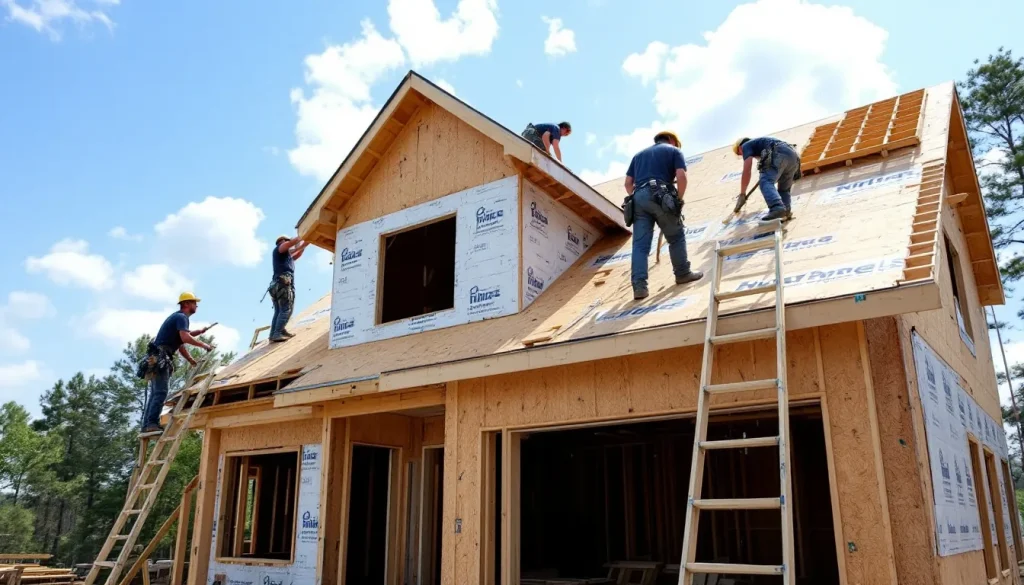
A new construction roofing project in 2026 is fundamentally different from a tear-off-and-replace job: you control the deck, the framing, the underlayment (see our best synthetic underlayment guide), the ventilation, the flashing, and the material choice from the ground up, with no legacy mistakes to work around. Production builders (D.R. Horton, Lennar, Pulte, KB Home) typically default to architectural asphalt shingles, OSB sheathing, synthetic underlayment, and ridge-and-soffit ventilation because that combination is cheap, fast, and code-compliant in nearly every US jurisdiction. Custom builders have more material flexibility but the same five spec details matter most: sheathing thickness and nailing pattern, underlayment selection, ice and water shield placement, ventilation balance, and flashing methodology at every penetration and wall junction. Get those five right at framing and the roof will outlast the warranty period of the material itself. Get them wrong and you’ve built a 15-year roof on a 25-year house.
The short version
- Production builders use architectural asphalt shingles ~85% of the time. Custom builders pick from the full materials list.
- IRC 2024 requires minimum 7/16-inch OSB sheathing at 24-inch rafter spacing; 1/2-inch is the practical residential standard.
- Sheathing nailing pattern: 6-inch edge, 12-inch field for standard load; 4-inch edge in high-wind zones.
- Synthetic underlayment is the 2026 default. Felt is legal but reduces lifespan.
- Ice and water shield required at eaves in any climate zone with average January temp under 25°F.
- Balanced ridge-and-soffit ventilation: 1:300 net free area rule per IRC R806.
- Five spec details matter most: sheathing/nailing, underlayment, ice and water shield, ventilation, flashing.
How new construction roofing differs from a tear-off
On a reroof project, the existing roof structure dictates most of the decisions: pitch, framing, deck condition, ventilation pathways, and penetration locations are all fixed. You’re working with what’s there. On a new build (see our commercial new-build roofing guide), none of that is fixed. The roof can be optimized at every stage: rafter sizing for snow load, deck thickness for the chosen material, ventilation designed in from day one rather than retrofitted, and flashing pre-planned at every penetration before the first shingle goes on.
This control is the biggest cost-saver and performance booster in new construction roofing. A custom builder who specs the roof correctly at framing avoids the $2,000 to $5,000 in retrofits that show up on average reroofs to fix legacy ventilation, sheathing, or flashing problems. The catch is that “specs correctly at framing” requires either a knowledgeable builder, a competent architect, or a homeowner willing to dictate the five spec details below to the framing crew.
Production builder vs custom builder material choices
The roofing material choice on new construction tracks closely with the builder type. Production builders (the top 20 US homebuilders) spec for cost and speed. Custom builders spec for the homeowner’s stated preference.
| Builder type | Typical material | Typical pitch | Why |
|---|---|---|---|
| Production (D.R. Horton, Lennar, Pulte, KB Home) | Architectural shingles | 4:12 to 6:12 | Cost per sf is lowest; install crews are familiar; works in all climates |
| Production luxury | Architectural shingles or concrete tile | 5:12 to 8:12 | Concrete tile in Sun Belt; shingles elsewhere |
| Custom builder (mainstream) | Architectural shingles or standing-seam metal | 6:12 to 9:12 | Homeowner preference; metal is growing share |
| Custom builder (luxury) | Designer shingles, slate, tile, standing-seam | 6:12 to 12:12 | Aesthetic and longevity priority |
| Modular and manufactured | 3-tab or architectural shingles | 3:12 to 5:12 | Transport-pitch limitation; cost optimized |
For the full materials reference, see our roofing materials list. For asphalt shingle lifespan detail, see asphalt shingle roof lifespan. For the metal-vs-shingle decision in new construction, see metal vs asphalt shingle roof.
Sheathing: thickness, span, and nailing
The roof deck is the foundation under every other roofing decision. Specifying the wrong sheathing thickness or nailing pattern voids manufacturer shingle warranties and creates wind-uplift failure points.
Sheathing thickness by rafter spacing
- 16-inch rafter spacing: 7/16-inch OSB minimum, 1/2-inch OSB recommended, 5/8-inch in heavy snow zones
- 24-inch rafter spacing: 1/2-inch OSB minimum, 5/8-inch recommended, 3/4-inch in heavy snow zones
- Truss spacing (24-inch typical): 1/2-inch OSB is the practical default; 5/8-inch for premium tile loads
IRC 2024 Table R503.2.1.1(1) sets the minimum sheathing thickness by rafter or truss spacing. Most builders spec one step thicker than the minimum because the marginal cost (around $0.30 to $0.50 per square foot (see our roof cost per square foot guide)) is small compared to the structural benefit and the ability to drive shingle nails fully without breaking through the underside.
OSB vs plywood
OSB (oriented strand board) is the default in 2026 new construction because it’s about 20% cheaper than plywood at the same thickness. Plywood holds nails slightly better, handles moisture exposure better during framing, and is preferred for premium custom homes. For production builds, OSB is fine if it stays dry during construction.
Sheathing nailing pattern
The fastener pattern that holds the sheathing to the rafters drives the entire roof’s wind resistance. Most production builders nail 6-inch edge, 12-inch field with 8d common nails (8d nails are the IRC minimum). High-wind zones (FL, Gulf Coast, NC/SC coast, parts of TX) require 4-inch edge, 6-inch field with 8d ring-shank or 10d common.
The 6-12 pattern handles up to 130 mph design wind. The 4-6 pattern handles 150 mph and above. Get this number from the design wind speed map (ASCE 7-22) for your specific site before framing starts. Re-nailing sheathing after the framing inspection passes is expensive and disruptive.
Underlayment: synthetic is the 2026 default
Underlayment is the secondary water barrier between the sheathing and the shingles. It’s the last line of defense when wind-driven rain gets under shingles, when shingles fail prematurely, or when ice dams push water uphill. In new construction, the underlayment goes on right after the sheathing is decked.
Synthetic underlayment
The 2026 default for new construction. Polypropylene or polyester woven mat. Doesn’t tear, stays flat in wind, lasts 25 to 50 years exposed to UV (during construction delays), and walks safely when wet. Cost is $0.30 to $0.60 per square foot installed. Major brands: GAF Tiger Paw, Owens Corning ProArmor, IKO Armourbase Pro.
30-pound felt (legal but obsolete)
Asphalt-saturated felt. Cost is $0.20 to $0.35 per square foot installed. Tears easily, wrinkles when wet, lasts 6 to 8 weeks exposed before degrading. Still allowed by IRC but increasingly excluded by shingle manufacturer warranty programs.
For the full comparison, see our felt vs synthetic underlayment guide. For new construction, the question isn’t whether to use synthetic, it’s which synthetic brand and how to install it. Synthetic underlayment runs $0.10 to $0.25 per square foot more than felt and adds 10 years of substrate durability. The math is obvious.
Coverage pattern
Underlayment runs horizontally with the bottom edge at the eave. Overlap upper sheets onto the lower sheets by 2 inches at horizontal seams and 4 inches at vertical seams. Fasten with cap nails or staples per the manufacturer’s pattern (usually 8 inches on edges, 16 inches in the field).
Ice and water shield: where it goes (and where it doesn’t)
Ice and water shield is a self-adhered modified bitumen membrane that sticks to the sheathing and self-seals around penetrations. It’s the highest-performance water barrier in residential roofing. Code requires it in specific locations; smart builders use it in additional ones.
Code-required locations (IRC R905.1.2 in cold zones)
- From the eave edge up to a point 24 inches inside the exterior wall line
- In valleys (typically 36 inches wide centered on the valley)
- Around all roof penetrations (skylights, vents, chimneys)
- At roof-to-wall transitions
Climate zone thresholds
The IRC requires ice and water shield in climate zones where the average January temperature is 25°F or lower. That covers most of the Northeast, Midwest, Mountain West, and Northern Plains. The Southern third of the country is exempt from the eave-membrane requirement but should still use it in valleys.
Smart additional locations
Even in non-ice-dam climates, premium new construction increasingly uses ice and water shield at:
- The bottom 36 inches of the eave (covers any wind-driven rain backup at the eave)
- Around chimneys, skylights, and large penetrations (insurance against flashing failure)
- In valleys (universal; the cheap insurance against valley leaks)
- At pitch transitions (where one roof plane meets another at a different angle)
The cost of ice and water shield is $0.50 to $0.90 per square foot. Even on a 2,500 sf home using it in all the locations above, total cost is around $400 to $700 for a substantial increase in long-term leak protection.
Ventilation: the 1:300 rule and balanced intake/exhaust
Attic ventilation is the largest controllable lifespan factor for shingle roofs after installation quality. In new construction, ventilation is designed in from framing. Retrofitting it later is expensive and often incomplete.
IRC R806 (the 1:300 rule)
Total net free ventilation area must equal 1/300 of the attic floor area, with the ventilation split between intake (low) and exhaust (high) vents. So a 2,000 sf attic needs 6.67 sf of net free vent area, split roughly 50/50 between soffit intake and ridge or gable exhaust.
Balanced intake and exhaust
Ridge vents need soffit vents to feed them. A roof with ridge vents but blocked or inadequate soffit vents pulls makeup air from the conditioned house below, dragging humidity into the attic. The result is condensation, mold, and shortened shingle life.
- Continuous soffit vents (perforated soffit panels) provide 7 to 9 sq in of net free area per linear foot
- Ridge vents provide 12 to 18 sq in of net free area per linear foot
- Gable vents are an alternative or supplement, especially on hip roofs without long ridge runs
- Powered attic fans should not be used in homes with continuous soffit-to-ridge ventilation; they fight the natural convection
Insulation interaction
Attic insulation must not block soffit vent intake. Baffle channels (also called insulation baffles or vent chutes) maintain a clear 1.5-inch airspace from soffit vent up to the ridge. New construction installs these as part of the insulation work; retrofits often skip them, leading to clogged soffit ventilation.
Flashing: every penetration, every junction
Flashing is where new construction roofing fails most often when it fails. The roof field can be perfect but if the flashings around the chimney, skylights, vents, and roof-to-wall junctions are wrong, the roof leaks. New construction is the chance to detail every flashing correctly from the start.
The flashing locations on every roof
- Drip edge along all eaves and rake edges (see our drip edge guide)
- Chimney flashing (step flashing and counter-flashing)
- Skylight flashing (curb flashing system per manufacturer)
- Vent pipe flashings (boot flashings around plumbing vents)
- Step flashing at every roof-to-wall transition (every shingle course)
- Headwall flashing at every roof-to-wall horizontal transition
- Valley flashing (open metal, woven, or closed-cut method)
- Apron flashing at wall-to-roof horizontal transitions (siding to roof)
Step flashing methodology
At every roof-to-wall transition, step flashing must be installed in individual pieces, one per shingle course. Continuous L-flashing is not acceptable; it traps water against the wall. Each step piece is bent 90 degrees with a 5-inch vertical leg and a 5-inch horizontal leg, woven into the shingle field as the courses go up the slope.
This is one of the most consistently wrong details on production new construction. Crews install continuous flashing to save time, the inspector misses it, and the homeowner discovers it five years later when the wall sheathing rots. Spec step flashing explicitly in the contract (see our roofing contract template guide).
For broader flashing detail, see our roof flashing guide.
The 2024 IRC code requirements
The International Residential Code (IRC) 2024 edition governs residential roofing in most US jurisdictions. The key new-construction code requirements are:
- Wind speed (R301.2.1): Design wind speed varies by region. Coastal areas require enhanced fastening patterns.
- Snow load (R301.2.3): Ground snow load per ASCE 7-22 maps drives rafter and truss sizing.
- Roof covering (R905): Material-specific requirements for each roofing type (R905.2 for asphalt shingles, R905.10 for metal, etc.).
- Underlayment (R905.1.1): At least one layer of underlayment required at any slope; double layer required below 4:12 for asphalt.
- Ice barrier (R905.1.2): Ice and water shield required at eaves in climates with average January temp ≤ 25°F.
- Ventilation (R806): 1:300 net free area, balanced intake and exhaust.
- Energy code (IECC 2024): Attic insulation R-value by climate zone (R-30 to R-60).
The five spec details to write into your contract
If you’re building a custom home (or buying production with the ability to negotiate upgrades), these five details have the largest impact on long-term roof performance and lifespan. Write them into the contract by name, not as “as per code.”
1. Sheathing thickness and nailing
Spec one step thicker than code minimum (1/2-inch OSB on 16-inch rafters, 5/8-inch on 24-inch). Spec 4-inch edge nailing in coastal zones, 6-inch edge in mainland. Spec 8d ring-shank nails (not smooth-shank) for premium wind resistance.
2. Synthetic underlayment
Spec synthetic by brand (GAF Tiger Paw, OC ProArmor, IKO Armourbase Pro) and full coverage of the entire deck. No felt anywhere.
3. Ice and water shield placement
Spec ice and water shield at all eaves up to 24 inches past the exterior wall line (or 36 inches for premium specification), all valleys, all roof-to-wall transitions, and around all penetrations. In southern climates, spec it in valleys and around penetrations at minimum.
4. Balanced ventilation
Spec continuous soffit vents (not just rectangular soffit vents) and continuous ridge venting. Spec baffle channels at every rafter bay to keep insulation off the soffit vents.
5. Step flashing methodology
Spec step flashing (individual pieces) at every roof-to-wall transition. Explicitly prohibit continuous L-flashing. Specify the metal (aluminum or copper) and the gauge (24 gauge minimum).
Material-specific new construction considerations
Architectural asphalt shingles (the default)
For the dominant 70%+ of new construction, architectural shingles are the right call. Pick a manufacturer-certified installer (GAF Master Elite, Owens Corning Platinum Preferred, CertainTeed SELECT ShingleMaster) to qualify for extended workmanship warranties. Spec 6-nail patterns for the published wind warranty.
Standing-seam metal
For premium new construction, standing-seam is increasingly the choice. The roof is designed around the panel module width (typically 16, 18, or 24 inches). Substrate is plywood (not OSB) for premium installs because of fastener pullout strength in the case of mechanical damage. Specify PVDF (Kynar 500) coating for color longevity.
Tile (clay or concrete)
Sun Belt new construction uses tile heavily. The structural design must accommodate the weight (600 to 1,200 lb/square). Rafters and trusses are typically upsized. Spec hurricane clips (tile retainer wires) in coastal areas.
Slate (natural or synthetic)
For high-end custom new construction. Natural slate requires specialized installers. Synthetic slate (DaVinci, Brava) installs like heavy shingles and doesn’t require specialized framing.
Coordination with other trades during new construction
New construction roofing only goes right when the framing, mechanical, electrical, and exterior trim trades cooperate. The common coordination failures:
Framing
Rafter or truss spacing wrong for the chosen material. Insufficient ventilation pathways through the framing. Missing structural ridge beam on cathedral ceilings.
Plumbing
Vent stack penetrations clustered too close together, or placed too close to walls/valleys for proper flashing.
HVAC
Bathroom and kitchen exhaust fans terminating in the attic instead of through the roof. Furnace flue placement crowding roof penetrations.
Electrical
Service entrance mast placement that interferes with roof flashing. Skylight wiring routing that conflicts with insulation baffles.
Exterior trim
Siding installer wraps housewrap up under the roof flashing (correct) or puts siding on first and roof flashing on top of the siding (wrong). Spec the sequence in the contract.
Inspection points during new construction
The homeowner or general contractor should personally walk the roof at four points during new construction.
Inspection 1: after sheathing
Check sheathing thickness (it’s the easiest time to see). Walk the entire deck. Verify nailing pattern (count nails in a sample area). Check for missing sheets or wrong material.
Inspection 2: after underlayment
Verify synthetic was used (not felt). Check overlaps. Verify ice and water shield is in place at eaves, valleys, and penetrations. Inspect baffle channel installation at the eaves before any insulation goes in.
Inspection 3: mid-shingle install
Walk the roof during the install (with the crew’s safety approval). Verify the 6-nail pattern. Check starter strip at the eaves. Verify step flashing at any roof-to-wall transitions that have been completed.
Inspection 4: post-install
Walk the finished roof. Verify ridge cap installation. Check drip edge (see our drip edge installation guide) at eaves and rakes. Inspect all penetrations for proper boot flashing. Verify gutters and downspouts are in place and pitched correctly.
Cost of new construction roofing
The roof on a new build typically costs 4% to 7% of total construction cost. For a 2,500 sf single-story home built at $300/sf ($750,000 total), the roof typically runs $30,000 to $52,000 including framing, sheathing, underlayment, ice and water shield, shingles, ridge vent, flashings, drip edge, gutters, and labor.
| Roof component | Cost range | % of roof total |
|---|---|---|
| Rafters/trusses + framing labor | $8,000 to $14,000 | ~30% |
| Sheathing + nailing | $3,500 to $5,500 | ~12% |
| Underlayment + ice and water shield | $2,000 to $3,500 | ~7% |
| Architectural shingles + ridge cap | $8,000 to $14,000 | ~28% |
| Drip edge, flashings, vents | $1,500 to $3,000 | ~6% |
| Gutters + downspouts | $2,500 to $4,500 | ~9% |
| Labor (shingles, flashings, accessories) | $4,500 to $7,500 | ~16% |
For metal, tile, or slate substitutions, the material line item grows substantially (often 2x to 5x the asphalt cost) but framing, underlayment, and labor lines stay similar. For per-square cost detail, see our roofing cost per square guide.
FAQ
What is the best roofing material for new construction?
It depends on climate, budget, and aesthetic. For most US single-family new construction, architectural asphalt shingles balance cost, lifespan, and installer availability. Standing-seam metal is the premium upgrade. Tile dominates Sun Belt. Slate is for high-end custom.
How thick should the roof sheathing be on new construction?
7/16-inch OSB minimum on 16-inch rafter spacing, 1/2-inch on 24-inch rafter spacing. Most builders spec one step thicker (1/2-inch on 16-inch, 5/8-inch on 24-inch) for the marginal cost increase and structural benefit.
Do I need ice and water shield on new construction in the South?
Code does not require it in the South (climate zones with average January temp above 25°F). However, smart builders use it in valleys and around penetrations even in southern climates because it’s cheap insurance against the most common leak locations.
What is the most common mistake in new construction roofing?
Continuous L-flashing at roof-to-wall junctions instead of step flashing. It traps water against the wall and rots the sheathing. The fix at construction is trivial; the retrofit is expensive.
How long should a new construction roof last?
An architectural shingle roof on new construction with proper installation, ventilation, and detailing should last 25 to 30 years. A standing-seam metal roof should last 40 to 60 years. The substrate (sheathing) should last the life of the house.
Can I install a metal roof over OSB sheathing in new construction?
Yes, with 1/2-inch or thicker OSB. Some premium standing-seam installers prefer plywood for fastener pullout strength, but OSB is acceptable and dominates production new construction in metal-roof markets.
Who actually installs the roof on production new construction?
Production builders subcontract roofing to dedicated crews who specialize in volume residential. Quality varies widely; the builder’s quality control is the main check. Insist on a manufacturer-certified installer (GAF Master Elite, etc.) for any premium upgrade.
Bottom line
New construction roofing is the chance to do it right from the ground up. The five details that matter most (sheathing thickness and nailing, synthetic underlayment, ice and water shield placement, balanced ventilation, step flashing methodology) are all locked in at framing and rough-in stages. Get them right and the roof outlasts the warranty period of the material itself.
For production new construction, architectural shingles with synthetic underlayment, proper ventilation, and step flashing at every wall is the right spec. For custom new construction, standing-seam metal, premium shingles, tile, or slate all work with the same five underlying detailing principles. The material changes; the detailing requirements don’t. Spec them by name in the contract and walk the roof at the four inspection points above. The 30-year roof depends on the decisions you make in the first 30 days of construction.