
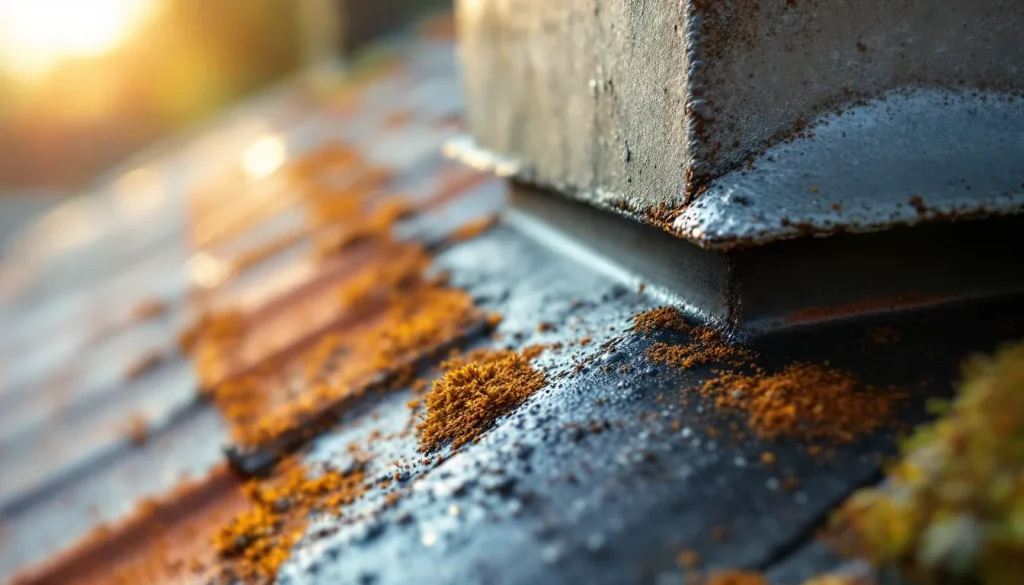
Roof flashing (see our what is flashing on a house) repair in 2026 costs $250 to $1,200 for typical residential jobs, but the real story is why flashing fails: oxidation of the metal itself, separation from the adjacent surface, missing or failed caulk at the seam, or improper original installation. Flashing failures cause an estimated 40 to 50 percent of residential roof leaks according to NRCA member data and IBHS post-storm research, which is why this small-dollar repair often prevents major roof damage. Knowing which type of flashing failed and what replacing it actually involves separates a $400 repair from a $1,500 mistake.
The short version
- Roof flashing repair runs $250 to $1,200 for typical jobs; chimney systems and multi-wall step flashing repairs can reach $1,800 to $3,000.
- Flashing failures cause 40 to 50 percent of residential roof leaks. Four main failure modes: oxidation, separation, caulk failure, and bad original install.
- The five flashing types you will encounter: step, counter, chimney (four-piece system), drip edge, valley, and vent pipe. Each fails differently.
- Aluminum is the default material for residential. Galvanized steel rusts faster than people think. Copper lasts 75+ years but costs 5 to 8 times aluminum.
- IRC R905.2.8 requires step flashing at wall transitions and prescribes how it must be installed. Most pre-2005 homes do not meet this standard.
- Polyurethane sealant, not silicone, for any flashing seam. Geocel 2300 and NPC Solar Seal 900 are the pro-grade choices.
The Short Answer: Repair Cost by Flashing Type
Pricing reflects 2026 national medians for asphalt shingle roofs at normal access. Steep-slope, multi-story, or specialty roofs run 30 to 80 percent higher.
| Flashing Type | Repair Cost (Pro) | Replace Cost (Pro) | DIY-Friendly? |
|---|---|---|---|
| Vent pipe boot | $150 to $250 | $200 to $400 | Yes (low slope) |
| Drip edge (per side) | $200 to $400 | $400 to $900 | No (full strip required) |
| Step flashing (single wall) | $300 to $700 | $500 to $1,200 | No |
| Counter flashing | $250 to $600 | $400 to $1,000 | No (masonry cut required) |
| Chimney (full 4-piece system) | $600 to $1,200 | $1,200 to $2,500 | No |
| Cricket addition (chimney over 30 inches) | n/a | $400 to $900 | No |
| Valley flashing | $400 to $900 | $800 to $2,400 | No |
| Skylight flashing | $300 to $700 | $500 to $1,600 | No |
What Roof Flashing Is (and the 5 Main Types)
Flashing is the thin metal that bridges the roof field and any transition: a wall, a chimney, a skylight, a vent stack, a valley, or the roof edge itself. Where the roof field shingles cannot shed water alone, flashing creates a watertight path that diverts flow back onto the field. A curb-mounted unit needs the same waterproof detail, covered in our evaporative cooler roof jack install guide.
The five flashing types on a typical residential roof:
- Step flashing at any wall-to-roof transition (dormers, second story walls, porches).
- Counter flashing over the top of step flashing (cut into mortar or behind siding).
- Chimney flashing is a four-piece system (apron, step, counter, cricket).
- Drip edge flashing at the eave (bottom edge) and rake (sloped sides).
- Valley flashing in the V where two roof planes meet.
- Vent pipe flashing (boot) around plumbing stacks.
Skylight flashing is a sixth specialized category, typically using a pre-formed kit from Velux or a similar manufacturer.
Step Flashing (Between Roof and Walls)
Step flashing is the L-shaped metal piece that sits between each shingle course and an abutting vertical wall. One piece per course, woven into the courses as the roof is laid. It is the most code-critical flashing on a roof and one of the most commonly botched.
How it should work:
- Each step piece is roughly 5 by 7 inches, bent at 90 degrees.
- The horizontal leg sits on the roof deck, covered by the next course of shingles.
- The vertical leg runs up the wall, covered by either siding (which sits about 1/4 inch above the shingle for capillary break) or by counter flashing.
- Each piece overlaps the one below by at least 2 inches.
How it fails:
- Original installer skipped step pieces and just caulked the siding to the shingles. Five to seven year failure guaranteed.
- Step pieces are too short to span the next course (less than 2 inch overlap).
- Step pieces oxidized over 30 to 50 years (aluminum) or rusted out (galvanized steel).
- A re-roof crew bent the existing step pieces flat and laid new shingles over them instead of replacing the pieces.
Proper step flashing repair requires lifting siding (or counter flashing), removing the failed pieces, weaving new pieces into the shingle courses, and replacing the cover. Cost: $500 to $1,200 per 10-foot wall transition. IRC R905.2.8.3 mandates step flashing at all wall transitions on asphalt shingle roofs.
Counter Flashing (Over Step Flashing)
Counter flashing is the second layer that sits over step flashing on masonry walls (chimneys, parapets) and behind siding on framed walls. Its job: keep wind-driven rain from running down behind the step flashing.
On masonry walls, counter flashing is installed by cutting a reglet (a horizontal slot) into a mortar joint with a diamond blade, inserting the top edge of the counter flashing into the slot, wedging it tight with lead wedges, and sealing with polyurethane. That cut and the seal are the entire integrity of the joint.
How counter flashing fails:
- The sealant in the reglet cracks and lets water in behind the counter flashing.
- The counter flashing pulls out of the mortar joint due to thermal movement.
- The original installer caulked the counter flashing to the chimney face instead of cutting a reglet. Two to five year service life on that joint.
- The chimney itself moves (settlement, freeze-thaw masonry damage) and tears the counter flashing free.
Re-sealing a reglet joint with polyurethane (Geocel 2300 or NPC Solar Seal 900) is a six-month to two-year patch. Full counter flashing replacement on a chimney runs $400 to $1,000 because the new reglet must be cut and the new metal installed in 24 to 48 inch sections to manage thermal expansion.
Chimney Flashing (the 4-Piece System)
Chimney flashing is one component, but it is actually four flashing pieces working together. Understanding all four is the only way to diagnose a chimney leak.
| Piece | Location | Function |
|---|---|---|
| Apron (base) | Downslope side of chimney | Diverts water around chimney base |
| Step flashing | Sides of chimney | One piece per shingle course, weaves into shingles |
| Counter flashing | All sides of chimney | Cut into mortar reglet, covers step and apron |
| Cricket (saddle) | Upslope side of chimney | Small ridge that diverts water around chimney |
IRC R903.2.1 requires a cricket on any chimney wider than 30 inches on the upslope side. This is the most commonly omitted code requirement on residential roofs. On a chimney 30 to 36 inches wide, a cricket adds $400 to $900 to the project. On wider chimneys (48+ inches), the cricket can be a $1,500 to $3,000 addition. Worth every dollar. A 36-inch chimney without a cricket will trap leaves, ice, and water on the upslope side and leak within 10 years.
The chimney repair scope by failure mode:
- Apron only failed: $300 to $600.
- Step flashing only: $400 to $800.
- Counter flashing only: $400 to $900 (reglet recut).
- Full four-piece system replacement: $1,200 to $2,500.
- Add cricket where none existed: $400 to $900.
Drip Edge Flashing (Eave/Rake Protection)
Drip edge is the L-shaped metal that runs along the eave (bottom edge) and rake (sloped side edges) of the roof. It serves two functions: it kicks water out away from the fascia so the wood does not rot, and it provides a clean edge for shingles to overhang.
IRC R905.2.8.5 has required drip edge on asphalt shingle roofs since the 2012 code cycle, but enforcement varies. Houses built in the 1970s, 1980s, and 1990s often have no drip edge at all. The fascia rots, the shingles curl over the edge, and water wicks back under the underlayment.
Drip edge cannot be retrofitted without partial roof work because it must be tucked under the underlayment at the eave and over the underlayment at the rake. Adding drip edge to an existing roof typically means stripping the first three courses of shingles, removing the underlayment edge, installing drip edge, replacing underlayment and shingles, and re-sealing. That is a $400 to $900 per side job.
Where the fascia has already rotted, fascia replacement adds $5 to $15 per linear foot to the project.
Valley Flashing (Closed vs Open Valleys)
Valleys carry concentrated water and need flashing engineered for that flow. Three configurations are common:
- Open metal valley. Exposed metal channel (typically 18 to 24 inch wide aluminum or galvanized W-valley metal), shingles cut back 4 to 6 inches on each side. Visible from the ground. Longest-lasting at 30 to 40 years for aluminum.
- Closed-cut valley. Shingles from one slope run through the valley, shingles from the other slope are cut back 2 inches from the centerline. Ice and water shield underneath. Service life 20 to 25 years.
- Woven valley. Shingles from both slopes interlace across the valley. Mostly seen on pre-2000 roofs. Service life 15 to 20 years. Largely discontinued because the valley accumulates debris and traps moisture.
Valley flashing repair on an open metal valley typically means replacing the metal (or sometimes just resealing edges) and lifting the adjacent shingles. $400 to $900 for a minor repair, $1,500 to $2,400 for a full valley rebuild. Closed-cut and woven valleys usually need a partial strip-and-rebuild because the failure is at the shingle interweave, not just the metal.
NRCA recommends a minimum 36-inch-wide self-adhered ice and water shield under all valleys regardless of climate. Older homes (pre-2007 in mild climates) often lack this membrane and leak repeatedly until it is added.
Vent Pipe Flashing and Boots
Vent pipe flashing is the metal flange and rubber collar that seals plumbing stack penetrations. The metal flange typically lasts 30 to 50 years (it is just aluminum or galvanized steel under shingles). The rubber EPDM collar cracks at 10 to 15 years in most climates and 7 to 10 years in high-UV regions. Exhaust penetrations such as a dryer vent through the roof use a dedicated hooded cap over the same base-flange principle.
Repair options:
- Full boot replacement. $20 to $40 in materials, 60 to 90 minutes of work. Lift shingles above and to the sides of the existing flange, pull nails, slide off old boot, install new, re-seat shingles. Lasts 15 to 25 years.
- Retrofit collar. Perma-Boot, Oatey Master Flash, or Lifetime Tool. $25 to $45 in materials, 20 to 30 minutes of work. Slides over the existing failed boot, seals with two stainless clamps. No shingle disturbance. Lasts 20+ years per manufacturer data.
- Lead boot. Premium choice for new construction. $40 to $80, lifetime service. Not commonly used in residential anymore due to material cost and lead-handling concerns.
Vent boot work is the single DIY-friendliest flashing repair. Low risk, cheap materials, fast. The same base-and-collar detail applies when you route a bathroom vent through the roof.
Why Flashing Fails (4 Main Causes)
Decades of NRCA training material and contractor field reporting point to four root causes for almost every flashing failure on a residential roof:
- Oxidation of the metal itself. Aluminum oxidizes slowly but eventually thins. Galvanized steel rusts when the zinc coating wears off (typically 25 to 40 years). Copper develops a patina but holds structure for 75+ years.
- Separation from the adjacent surface. Thermal expansion and contraction pull flashing away from masonry, siding, or shingles. The seal at the joint fails. Wind-driven rain finds the gap.
- Caulk failure. Silicone, asphalt cement, and cheap latex caulks all fail within 5 years on a roof. Polyurethane and tripolymer sealants are the only consumer-grade products with 15 to 20 year service life.
- Bad original installation. Wrong material (silicone on asphalt), missing components (no cricket, no counter flashing, no drip edge), shortcuts (caulk instead of step pieces). This is by far the most common failure mode on homes built before 2005.
Repair vs Replace Flashing
The decision tree for an individual flashing component:
- If the metal is intact and the failure is at a sealant joint: Re-seal with polyurethane. $50 to $250. Buys 5 to 10 years.
- If the metal shows oxidation, rust, or punctures: Replace the component. Cost varies by type ($300 to $1,500 typical).
- If multiple flashing locations on the same roof have failed: The roof is likely past its service life. Replacement is usually the better economic choice. See our signs you need a new roof guide for the decision framework.
- If a re-roof is planned in the next 3 to 5 years: Replace flashing during the re-roof. New shingles over old flashing is a common contractor mistake that produces 5 to 8 year leaks.
Materials: Aluminum vs Galvanized Steel vs Copper
| Material | Cost (per linear foot, installed) | Service Life | Best Use |
|---|---|---|---|
| Aluminum (0.019 to 0.027 gauge) | $3 to $6 | 40 to 60 years | Default residential choice |
| Galvanized steel (26 to 28 gauge) | $3 to $7 | 25 to 40 years | Hidden flashing only |
| Painted steel (Kynar coating) | $4 to $9 | 40 to 60 years | When color match required |
| Copper (16 to 20 oz) | $15 to $35 | 75+ years | Premium homes, historic restoration |
| Lead | $8 to $20 | 75+ years | Vent boots (uncommon now) |
The default for residential is aluminum. Copper is the right choice for high-end homes where the flashing will be visible (open valleys, exposed counter flashing on a stone chimney). Galvanized steel rusts faster than people expect. Use it only where it will be covered by shingles or paint.
The Caulk Question (Why Silicone Fails, What to Use Instead)
The most common DIY flashing repair mistake: grabbing a tube of generic silicone caulk and “fixing” the leak. Within 18 to 36 months, the silicone separates from the shingle granules, cracks under UV, and the leak returns.
The reasons silicone fails on asphalt roofs:
- Silicone does not bond well to the mineral granules on asphalt shingles. The bond is mechanical, not chemical, and fails quickly.
- Silicone shrinks as it cures, pulling away from porous surfaces.
- UV degradation breaks down the silicone polymer chain over 3 to 5 years.
- Once silicone has been applied, almost nothing else bonds to the residue. Removing failed silicone before re-sealing is a significant labor cost.
The right products:
| Product | Best For | Service Life |
|---|---|---|
| Geocel 2300 ProFlex | General flashing sealant, all weather | 15 to 20 years |
| NPC Solar Seal 900 | Premium tripolymer, masonry reglets | 20+ years |
| OSI Quad Max | Siding-to-flashing transitions | 15 to 20 years |
| Karnak 19 | Asphalt-cement-based flashing repair | 10 to 15 years |
DIY Flashing Repair (When It’s Safe)
The flashing repairs a competent homeowner can do safely on a low-slope (under 6/12), single-story roof:
- Re-seal a counter flashing reglet where the existing metal is intact but the sealant has cracked. Clean old sealant, apply Geocel 2300 with a caulk gun, tool smooth. $10 in materials.
- Replace a vent pipe boot with a retrofit collar. $25 to $45 in materials.
- Re-seal a flashing seam with a fresh bead of polyurethane sealant where the underlying metal is sound.
What homeowners should not attempt:
- Cutting new reglets in masonry (requires diamond blade and respirator).
- Replacing step flashing (requires lifting siding or counter flashing, weaving in new pieces).
- Replacing valley metal (requires lifting many shingles, working with concentrated water paths).
- Anything on a roof above 6/12 pitch or above one story.
OSHA 1926.501 requires fall protection above six feet for employers. The agency does not enforce against homeowners, but falls do not check employment status. A harness, anchor, and lifeline cost $150 to $300. Use them.
Pro Flashing Repair (Cost Breakdown)
What you are paying for when a roofer prices a flashing repair:
- Labor (60 to 75 percent of the cost): Lifting shingles, removing failed flashing, fabricating or sizing replacement pieces, re-sealing, replacing shingles.
- Materials (10 to 20 percent): Flashing metal, sealant, nails, ice and water shield where needed.
- Disposal (2 to 5 percent): Removed metal and shingles.
- Overhead and warranty (10 to 20 percent): Insurance, the truck, the office, and the workmanship warranty.
A reputable roofer should offer a written workmanship warranty of at least one year on a flashing repair and three to five years on a flashing replacement. If the warranty offered is “no warranty” or “we will come back if it leaks,” that signals a contractor who does not stand behind the work. Our walkthrough on how to choose a roofing contractor goes through the license, insurance, and warranty questions to ask.
Building Code Requirements (IRC R905.2.8)
The International Residential Code (IRC) sets the floor for residential roof flashing. Key sections:
- IRC R905.2.8.3 (Step flashing). Required at all wall-roof intersections on asphalt shingle roofs. One piece per shingle course, minimum 5 inches by 7 inches.
- IRC R905.2.8.5 (Drip edge). Required at eaves and rakes. Minimum 2 inch flange on the roof side, 1.5 inch flange down the fascia.
- IRC R903.2.1 (Crickets). Required upslope of chimneys wider than 30 inches.
- IRC R905.1.2 (Underlayment). Specifies ice and water shield requirements at valleys and eaves in climate zones 5 and higher (most of the northern US).
State and local jurisdictions adopt IRC with amendments. Some states (California, Florida) have stricter requirements. Always check the local code office before assuming standard practice applies.
ASTM D7158 and ASTM D3161 set the wind resistance standards for asphalt shingles, but the flashing test methods are covered separately in ASTM D5957 (sealing materials) and ASTM E331 (water penetration).
FAQs
How long does roof flashing last?
Aluminum flashing lasts 40 to 60 years. Galvanized steel lasts 25 to 40 years. Copper lasts 75+ years. The sealants at flashing joints typically need refresh every 15 to 20 years even when the metal is still sound.
Can I just caulk a roof flashing leak?
For a short-term patch (6 to 18 months), yes, using polyurethane sealant like Geocel 2300. For a permanent repair, the failed component (metal, boot, sealant joint) needs proper replacement. Silicone caulk specifically is the wrong product and will fail within 18 to 36 months.
What is the difference between flashing and counter flashing?
Step flashing is the first layer that sits between each shingle course and an abutting wall, bent at 90 degrees. Counter flashing is the second layer that comes down from the wall (cut into mortar or behind siding) and covers the top edge of the step flashing. You need both for a code-compliant install.
Should I replace all roof flashing during a re-roof?
Yes. New shingles over old flashing is one of the most common contractor shortcuts and produces five to eight year leak patterns. A quality re-roof scope includes new flashing at every wall transition, chimney, vent, and valley.
How much does chimney flashing cost in 2026?
A full four-piece chimney flashing system on a typical residential chimney runs $1,200 to $2,500 installed in 2026. Repairs to a single component (apron only, counter flashing only) run $300 to $900. Adding a missing cricket on a chimney wider than 30 inches adds $400 to $900.
Does insurance cover roof flashing repair?
Standard HO-3 policies cover sudden damage from covered perils (wind, hail, falling objects). Flashing failure from age, wear, or bad original installation is excluded under maintenance and wear and tear language. If a storm caused the failure, file a claim. Our guide on filing an insurance claim for roof damage walks through the documentation.
Is roof flashing repair a DIY job?
Vent pipe boot replacement with a retrofit collar is genuinely DIY-friendly on low-slope roofs. Re-sealing a sound counter flashing reglet is reasonable. Step flashing, valley work, chimney work, and skylight flashing should go to a licensed roofer. Our Perma-Boot vent repair guide covers when to patch versus replace.