
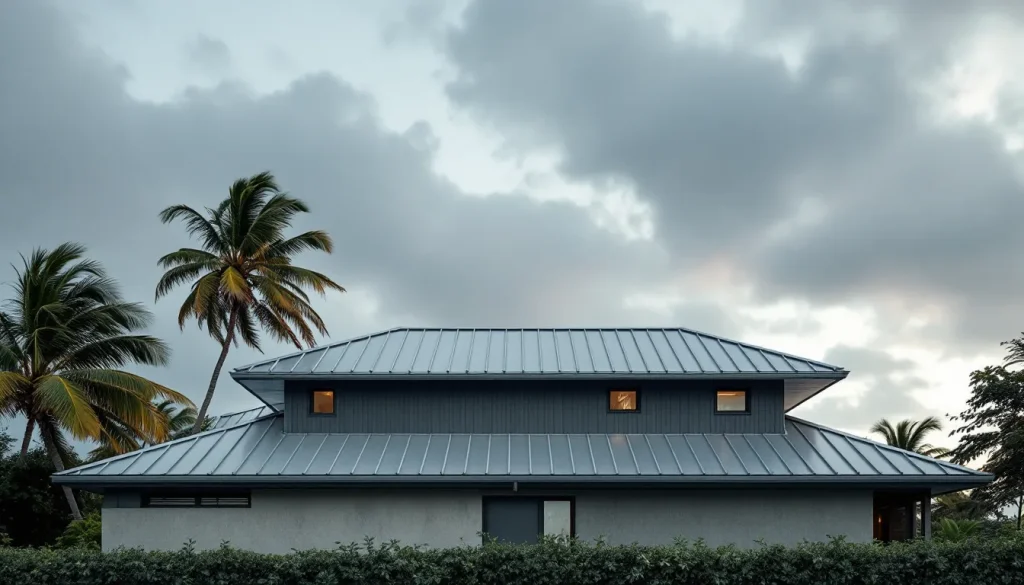
The best roof for hurricane (see our Florida residential roofing market shift) zones in 2026 is a properly installed metal standing seam roof with hurricane straps, rated for at least 150 mph wind uplift, installed to the IBHS FORTIFIED Roof Standard. That combination earns the deepest insurance discounts and survives Category 4 and Category 5 storms with the lowest claim rate of any residential assembly. Asphalt shingle roofs can also work in hurricane zones, but only with specific upgrades: an ASTM D7158 Class H wind rating, a sealed roof deck, ring-shank nails at code-mandated spacing, and a FORTIFIED designation. The cost premium for a true hurricane roof system runs 15 to 40 percent over conventional roofing, and the insurance discount stack plus reduced claim risk typically pays that back in 8 to 15 years.
The short version
- Metal standing seam with 150 mph wind rating, sealed deck, hurricane straps, FORTIFIED Gold is the gold standard. Cost: $14 to $22 per square foot installed.
- Concrete tile holds up well in winds to 150 mph but suffers tile breakage that triggers repair claims even when the roof system survives.
- FORTIFIED asphalt shingles are the affordable hurricane option at $7 to $10 per square foot, but require a Class H rating and proper installation.
- Florida Building Code Section 1626 governs High Velocity Hurricane Zone (HVHZ) work in Miami-Dade and Broward; Miami-Dade Notice of Acceptance (NOA) is required on every component.
- Insurance discounts stack: FORTIFIED Gold can cut wind premium 30 to 45 percent; hurricane straps 10 to 30 percent; sealed roof deck 5 to 15 percent.
- Use a Florida-licensed certified roofing contractor (CCC license) and document everything with Form OIR-B1-1802.
The Short Answer: Material plus Installation plus Rating
The phrase “hurricane (for the full data set, see the 2026 Roofing Hail and Storm Loss Database) proof roof” is technically inaccurate. No roof is fully hurricane proof. The honest framing is hurricane resistant, and resistance is built from three layers stacked together. First, the material itself must carry a wind rating. ASTM D7158 Class H certifies asphalt shingles for 150 mph wind, while ASTM D3161 Class F applies to lower-velocity products. Metal standing seam panels carry UL 580 Class 90 and Miami-Dade NOA wind-uplift ratings. Concrete and clay tile must pass TAS 102 and TAS 125 testing for HVHZ counties.
Second, the installation must follow current Florida Building Code (2024 edition, effective for permits pulled after January 1, 2026). Code Section 1626 covers HVHZ; Section 1504 covers all other Florida zones. Nail patterns, underlayment requirements, ring-shank fasteners, and starter strip rules are not suggestions. A correctly rated material installed incorrectly will fail at 110 mph.
Third, the system needs structural continuity from roof deck to wall framing to foundation. That is the hurricane strap question, covered in detail in our hurricane roof straps guide. Without straps, the wind lifts the roof off the walls and the rest of the system becomes irrelevant.
Metal Standing Seam: Why It Wins
Metal standing seam roofs lead the hurricane category for three reasons. The interlocking panel design eliminates exposed fasteners along the field of the roof, so there is no edge for wind to catch and peel. The panels carry uplift ratings of 150 to 180 mph in standard installations and 200 mph or higher in specialty configurations. And the long panel lengths reduce seam count, which reduces failure points.
Real-world performance data from the Insurance Institute for Business and Home Safety (IBHS) and post-storm field assessments after Hurricane Ian (2022), Hurricane Idalia (2023), and Hurricane Helene (2024) consistently show metal standing seam roofs survive at higher rates than any other residential material. After Hurricane Ian, IBHS field teams reported 92 percent of standing seam metal roofs in the surveyed Cape Coral and Fort Myers corridor showed no significant damage, versus 64 percent of asphalt shingle roofs in the same windfield.
The tradeoffs are real. Metal standing seam costs $14 to $22 per square foot installed for hurricane-rated configurations, compared to $7 to $10 for FORTIFIED asphalt shingle. See our standing seam metal roof cost guide for the detailed cost breakdown. The other concern is denting from large hail, though most insurers in Florida price hail risk lower than wind risk.
Concrete Tile: Heavy, Durable, But Tile Loss Possible
Concrete and clay tile carry strong hurricane credentials in lab testing. Properly installed tile to Florida Building Code with foam adhesive systems or mechanical fastening passes wind ratings of 150 mph. Tile is the dominant roofing material in Miami-Dade, Broward, and the Florida Keys for aesthetic and code reasons.
The honest issue with tile in hurricanes is field experience. After major storms, even tile roofs that maintain structural integrity often suffer 20 to 200 individual tile losses from windborne debris impact. Each lost tile creates a leak point. Carriers pay tile repair claims at high frequency even when the underlying roof structure performs well. The result: insurance discounts on tile are smaller than on metal standing seam in most Florida programs, despite the wind rating parity.
If you choose concrete tile for hurricane country, the installation method matters enormously. Foam-set systems with proper edge metal generally outperform older mortar-set systems. Hurricane clips at the eaves and rakes are non-negotiable. And the underlayment must be a self-adhered membrane that maintains waterproof integrity if tiles do come off.
FORTIFIED-Rated Asphalt Shingle
For homeowners who want hurricane resistance without the metal price premium, a FORTIFIED-designated asphalt shingle roof is the practical answer. The shingle must carry ASTM D7158 Class H certification (150 mph). The installation requires ring-shank nails at six-nail patterns, a sealed roof deck (either a fully adhered self-adhered underlayment or taped seams with peel-and-stick), starter strips at all eaves and rakes, and verified ridge cap installation per manufacturer specs.
FORTIFIED Roof costs $7 to $10 per square foot installed in Florida, compared to $5 to $7 for a standard architectural shingle install. Most shingle brands that participate in the FORTIFIED program (CertainTeed Landmark Pro, GAF Timberline HDZ, Owens Corning Duration Storm) carry Class H wind ratings out of the box. The premium comes from the deck preparation, fasteners, and installation verification rather than the shingles themselves. For a deeper look at material tradeoffs, see metal vs asphalt shingle roof.
The Wind Rating Math: ASTM D7158 Class H = 150 mph
ASTM D7158 is the wind classification standard for asphalt shingles. The classifications run D (90 mph), G (120 mph), and H (150 mph). Florida Building Code requires Class H for HVHZ counties and recommends Class H or Class G for all coastal counties depending on the wind zone map.
The math behind the rating accounts for both wind speed and shingle uplift resistance using fastener pull-through testing, sealant bond strength at temperature, and asymmetric loading models. A Class H shingle on a properly nailed deck in a code-compliant installation has a 95th-percentile survival rate in a 150 mph sustained wind. The qualifier “properly installed” carries all the weight. Field studies after Hurricane Michael (Category 5, 2018) showed Class H shingles failing at sustained winds of 110 to 130 mph when nailed incorrectly (high-nailing into the asphalt layer instead of the nail strip).
| ASTM D7158 Class | Wind Rating | Required Where |
|---|---|---|
| Class D | 90 mph | Interior zones only |
| Class G | 120 mph | Most Florida counties (non-HVHZ) |
| Class H | 150 mph | HVHZ (Miami-Dade, Broward) + recommended coastal |
Florida Building Code Section 1626: The HVHZ Zone
The 2024 Florida Building Code Section 1626 covers High Velocity Hurricane Zones, defined as Miami-Dade County and Broward County. Every roofing material installed in HVHZ must carry a Miami-Dade Notice of Acceptance (NOA) issued by the Miami-Dade Product Control Section. The NOA process tests products against TAS 100 (water resistance), TAS 102 (wind uplift), TAS 124 (impact resistance), and TAS 125 (tile-specific).
Outside the HVHZ but still in coastal counties (Palm Beach, Monroe, Collier, Lee, Sarasota, Pinellas), the code references the same Miami-Dade test methods but allows Florida Product Approvals as an alternative. Permitting inspectors in counties like Lee and Charlotte have been pushing toward NOA-only acceptance after Hurricane Ian, even where state code allows the Florida approval as an alternate.
The practical implication: every component touching your roof in HVHZ must have documentation. Underlayment, drip edge, ridge vent, starter strip, primary roof covering, and fasteners all carry separate NOA numbers. Roofing contractors maintain NOA binders on every active job site and inspectors check them.
Miami-Dade Notice of Acceptance
A Miami-Dade NOA is a product-specific approval document with a unique number, an expiration date (typically 5 years), and detailed installation requirements. The NOA spells out the substrate it can be installed on, the maximum slope, the wind speed it survives, the fasteners required, the spacing pattern, and the perimeter and corner enhancements needed.
Common NOA numbers contractors will reference in 2026: GAF Timberline HDZ shingles (NOA 22-0518.03), CertainTeed Landmark Pro (NOA 22-0712.04), Owens Corning Duration Storm (NOA 23-0117.05), Boral concrete tile (NOA 23-0405.02), and Eagle Roofing concrete tile (NOA 23-0612.07). NOA numbers update annually. Always verify the NOA listed on the contractor’s permit application is current at the Miami-Dade Product Control online database.
FORTIFIED Roof Program (IBHS): Three Tiers
The IBHS FORTIFIED Roof Standard is a third-party verified construction protocol developed by the Insurance Institute for Business and Home Safety. It has three tiers: FORTIFIED Roof, FORTIFIED Silver, and FORTIFIED Gold. Each tier adds requirements.
FORTIFIED Roof (base tier) requires: sealed roof deck, enhanced ring-shank fasteners (8d at 6 inches on edges and 12 inches in field, minimum), starter strip on all eaves and rakes, drip edge on all edges, and a high-wind rated roof covering. FORTIFIED Silver adds: enhanced gable end bracing, attic ventilation that resists wind-driven rain, and chimney and skylight reinforcement. FORTIFIED Gold adds: continuous load path from foundation to roof, gable end bracing, garage door reinforcement, and impact-rated openings.
| FORTIFIED Tier | Key Requirements | Typical Insurance Discount |
|---|---|---|
| FORTIFIED Roof | Sealed deck, ring-shank nails, edge protection | 10 to 20 percent on wind |
| FORTIFIED Silver | + gable bracing, sealed attic ventilation | 20 to 30 percent on wind |
| FORTIFIED Gold | + continuous load path, garage reinforcement, impact glazing | 30 to 45 percent on wind |
Verification is performed by an IBHS-credentialed third-party evaluator, not the roofing contractor. The designation is recorded with IBHS and transfers with the property. As of mid-2026, FORTIFIED designations are recognized for premium discounts by every major Florida wind carrier including Citizens, State Farm Florida, Tower Hill, Slide Insurance, and Universal Property and Casualty.
Hurricane Straps and Clips: The Load Path Question
A hurricane-rated roof covering on a structure without hurricane straps is half a system. The roof covering can survive 150 mph winds but the entire roof structure can still lift off the walls. Hurricane straps and clips tie the roof rafters or trusses to the top wall plate, creating a continuous load path that transfers uplift forces down through the walls to the foundation.
Florida Building Code Section 1626 requires hurricane straps on all new construction in HVHZ. Most other Florida counties require straps on new construction and on substantial reroofs. For existing homes, hurricane strap retrofit during a reroof costs $50 to $150 per strap installed and can qualify for additional insurance discounts of 10 to 30 percent. See our complete hurricane roof straps guide for retrofit options.
Sealed Roof Deck Systems
A sealed roof deck is required for FORTIFIED designation and strongly recommended for any roof installed in hurricane country. The principle is simple: if your primary roof covering fails or blows off during a storm, the roof deck itself must remain waterproof long enough for you to repair or replace the covering after the storm passes.
There are two approved methods. Method 1 is a fully adhered self-adhered membrane over the entire roof deck (peel-and-stick underlayment such as GAF StormGuard, CertainTeed Winterguard, or Owens Corning WeatherLock). Method 2 is taped seams: standard synthetic underlayment with all seams between adjacent OSB or plywood sheets sealed with self-adhered flashing tape.
Method 1 costs $0.80 to $1.40 per square foot in materials. Method 2 costs $0.30 to $0.60 per square foot in materials but adds labor. Method 1 is the more reliable option for high-wind events because it eliminates the possibility of installer error in tape application.
Insurance Discount Math: 10 to 45 Percent by Carrier
Insurance discounts for hurricane-rated roofs in Florida are documented through Form OIR-B1-1802, the Uniform Mitigation Verification Inspection Form. The form scores ten mitigation features: roof covering, roof deck attachment, roof-to-wall connection, roof geometry, secondary water resistance, opening protection, wall construction, terrain exposure, building code edition, and roof shape. The wind premium discount is calculated from the combined score.
| Mitigation Feature | Typical Wind Premium Discount |
|---|---|
| FORTIFIED Gold designation | 30 to 45 percent |
| FORTIFIED Silver designation | 20 to 30 percent |
| Single hurricane wraps (clips) | 10 to 20 percent |
| Double hurricane straps | 20 to 30 percent |
| Sealed roof deck (SWR) | 5 to 15 percent |
| Hip roof geometry | 10 to 25 percent |
| Impact-rated openings | 15 to 30 percent |
The discounts compound but not additively. A FORTIFIED Gold home with hip roof and impact glass might see a 50 to 60 percent total wind premium discount, not a 75 percent discount you would get by adding the individual percentages. Citizens Property Insurance, the state-backed carrier of last resort, publishes the most transparent mitigation matrix. Private carriers use proprietary algorithms but follow similar logic.
Cost Premium for Hurricane-Rated Roofing
Cost data below comes from 2026 Florida contractor pricing on 25 square (2,500 square feet) tear-off and replacement projects in Lee, Collier, Sarasota, and Palm Beach counties. For broader cost ranges see how much does a new roof cost.
| Roof System | Total Cost | Per Square Foot |
|---|---|---|
| Standard 30-year architectural shingle (Class G) | $13,000 to $18,000 | $5 to $7 |
| FORTIFIED Roof asphalt shingle (Class H) | $18,000 to $25,000 | $7 to $10 |
| FORTIFIED Gold asphalt shingle | $22,000 to $30,000 | $9 to $12 |
| Concrete tile (foam-set, HVHZ) | $28,000 to $40,000 | $11 to $16 |
| Metal standing seam (Galvalume, 24 gauge) | $35,000 to $55,000 | $14 to $22 |
| FORTIFIED Gold standing seam | $45,000 to $65,000 | $18 to $26 |
The premium for FORTIFIED Gold over standard installation runs 25 to 40 percent. The insurance savings, combined with reduced post-storm repair costs and avoided deductibles (Florida hurricane deductibles run 2 to 10 percent of dwelling coverage), typically recoup the premium in 8 to 15 years for homeowners in coastal counties. In Miami-Dade and Broward, the payback can be as fast as 5 to 7 years.
Florida Roofer Licensing for HVHZ Work
HVHZ roofing requires a Florida state certified roofing contractor (CCC license) or a Miami-Dade or Broward-specific certificate of competency for the roofing trade. Registered roofing contractors (RC license) cannot legally pull permits for HVHZ work without supervision by a certified contractor. Verifying your contractor’s license before signing is the single most important step in a hurricane reroof. See Florida roofing contractor license for the full licensing breakdown.
The Florida Department of Business and Professional Regulation (DBPR) license lookup at MyFloridaLicense.com lets you check any contractor’s CCC number, status, and complaint history. Miami-Dade requires an additional Certificate of Competency from the Miami-Dade Construction Trades Qualifying Board on top of the state license.
The Reroof vs New Construction Difference
New construction in HVHZ must meet current Florida Building Code in full. Reroofs are governed by Section R908 of the Florida Existing Building Code, which has somewhat lower thresholds for some components. Specifically: roof-to-wall connection upgrades are only required on reroofs when more than 25 percent of the roof structure is exposed during the reroof. This is the “25 percent rule” that determines whether hurricane straps must be added during a reroof project.
The practical implication: a homeowner doing a complete tear-off and redeck triggers the strap upgrade requirement. A homeowner doing a re-cover (new shingles over existing) generally does not. Florida Statute 553.844 (“Hurricane Mitigation Retrofits”) incentivizes voluntary strap retrofit during any reroof through the My Safe Florida Home grant program, currently funded at $200 million through 2027 with grants up to $10,000 per home for wind mitigation including hurricane straps.
AOB Compliance in Hurricane Repairs
Assignment of Benefits (AOB) reform took effect in Florida through HB 7065 (2019), SB 76 (2021), and SB 2-A (2022). The current rules (as of 2026) substantially restrict AOB use in residential roofing claims. A roofing contractor offering to handle your insurance claim and take an AOB in exchange for “free” work is operating in a heavily regulated space. See Florida AOB roofing reform for the current legal landscape.
For hurricane damage claims specifically: file the claim yourself with your carrier first, document damage with photos and video, get a written estimate from a licensed roofer (not the same one who will do the work, ideally), and use the carrier’s preferred contractor network only if you have verified the contractor independently. For broader insurance claim guidance see filing an insurance claim for roof damage.
The Right Way to Vet a Hurricane Roof Contractor
Hurricane country has the highest density of legitimate, technically skilled roofing operators in the country. It also has the highest density of storm-chasing scam operators. The largest legitimate Florida operators (Best Roofing, Kelly Roofing, Tadlock Roofing, RoofClaim, Tropical Roofing Products platform companies) all hold current CCC licenses, carry $1 million or higher general liability coverage, employ in-house Florida-licensed insurance claim handlers where applicable, and provide IBHS FORTIFIED documentation as a standard deliverable.
Several roofing platforms have rolled up Florida operators in the 2022 to 2025 window. Centerbridge Partners-backed Apex Service Partners includes roofing in some markets. Saw Mill Capital backs Florida regional roofers. Audax Group has roofing platforms operating across the Sun Belt. Roll-up ownership does not predict quality either way; what matters is the local license, the local crew, and the documented track record. For broader contractor vetting see how to choose a roofing contractor.
Frequently Asked Questions
What is the absolute best roof for hurricane resistance?
A FORTIFIED Gold-designated metal standing seam roof with 150 mph wind rating, hurricane straps installed to current Florida Building Code, sealed roof deck, and impact-rated openings on the rest of the home. That combination has the lowest claim rate in Florida insurance industry data over the 2020 to 2025 window.
Can asphalt shingles really handle hurricanes?
Yes, with the right product and installation. ASTM D7158 Class H shingles installed to FORTIFIED specifications (ring-shank nails, sealed deck, proper starter strips) survive sustained 150 mph winds in field testing and after major storms. The installation matters more than the shingle brand.
How much does a hurricane-rated roof cost compared to standard?
FORTIFIED Roof asphalt shingle costs about 30 to 50 percent more than a standard architectural shingle install ($7 to $10 per square foot vs $5 to $7). FORTIFIED Gold metal standing seam runs $18 to $26 per square foot vs $5 to $7 for entry-level shingle.
Will insurance pay for a hurricane roof upgrade?
Insurance does not pay for upgrades during normal replacement, but Florida’s My Safe Florida Home program offers grants up to $10,000 for hurricane mitigation including straps, sealed deck, and impact glazing. After a covered hurricane claim, insurance pays to restore to current code under “Ordinance or Law” coverage if you carry it.
Do I need hurricane straps if I get a new roof?
If your reroof exposes more than 25 percent of the roof structure, Florida code requires hurricane strap upgrade. If you re-cover existing decking, it is voluntary but qualifies for insurance discount and My Safe Florida Home grants.
What is the difference between FORTIFIED Roof and Florida Building Code?
Florida Building Code is the legal minimum. FORTIFIED Roof is a higher voluntary standard verified by IBHS-credentialed third parties. FORTIFIED earns insurance discounts that code-minimum installation does not.
How long does a hurricane-rated roof last?
FORTIFIED asphalt shingles carry 30 to 50 year manufacturer warranties. Metal standing seam roofs in Florida coastal exposure last 40 to 60 years with proper coating maintenance. Concrete tile lasts 50 plus years. See how long does a roof last for the full breakdown.
Is concrete tile or metal better for Miami-Dade?
Both work. Concrete tile fits the aesthetic of most South Florida neighborhoods and meets HVHZ code. Metal standing seam has better field performance after major storms but is less common visually. Insurance discounts favor FORTIFIED designation over material type.