
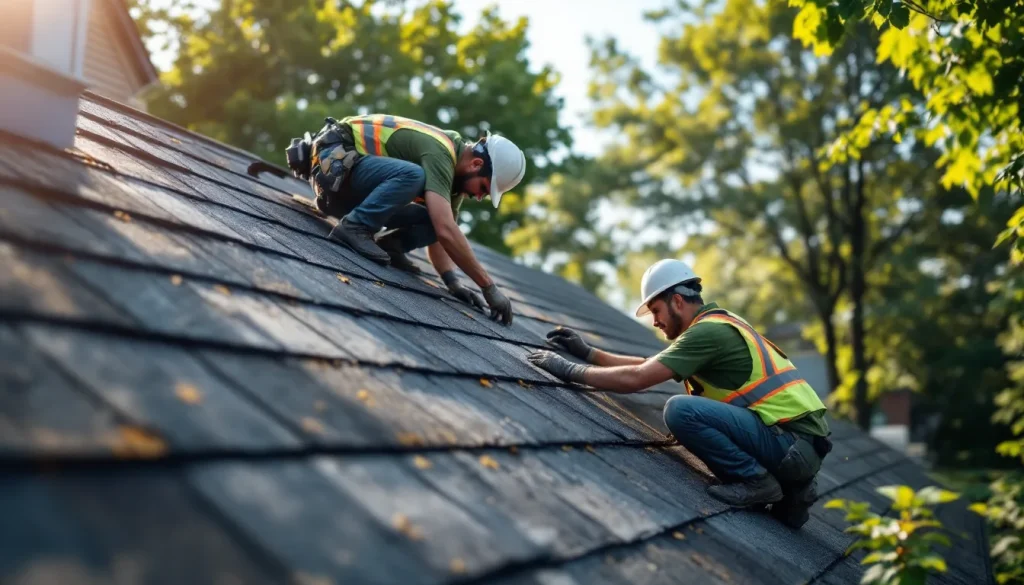
Asphalt shingle roof services cover everything from a $200 boot replacement to a full $32,000 tear-off and reroof. The trouble is that most contractor (for the full data set, see our the 2026 Roofing Contractor Industry Report) websites lump all of it under “roofing services” and let the homeowner figure out which service they actually need. The wrong call (calling a full replacement contractor for a leak that needed a $400 valley repair) wastes thousands. The other wrong call (paying for repeat patches on a roof that is past its service life) wastes thousands a different way. This guide breaks down every asphalt shingle service category, what each one costs in 2026, what brands and materials are typically involved, and how to tell which service your roof actually needs.
Service 1: full new install or replacement
Full replacement (tear-off plus install) is the largest service category and the one that consumes most of a residential roofing contractor’s revenue. In 2026, a full tear-off and replacement on a typical 2,000 square foot home (roughly 20 to 24 roofing squares) runs $4 to $7 per square foot installed, equating to $11,000 to $28,000 depending on materials, region, complexity, and contractor. Coastal California, the Pacific Northwest, and parts of New England run higher. Texas, the southeast, and much of the Midwest run lower. We cover regional pricing in detail in our roof cost per square foot reference.
The shingle brand matters for both cost and longevity. The mainstream options in 2026 are GAF Timberline HDZ (the most-installed architectural shingle in the United States), Owens Corning Duration (the second most-installed and our pick for wind warranty depth), CertainTeed Landmark (top finish quality and color depth), IKO Cambridge (Canadian-made, common in the upper Midwest and the northeast), Atlas Pinnacle Pristine (with the 3M Scotchgard algae-resistant coating), Tamko Heritage (regional pricing leader in the south-central states), and Malarkey Vista (rubber-modified asphalt, strong performer in hail-prone regions). Each brand has trade-offs in warranty, wind rating, hail resistance, and color selection. Our individual brand reviews cover the details (see GAF Timberline HDZ review, Owens Corning Duration review, CertainTeed Landmark review, and Atlas Pinnacle Pristine review).
A proper full replacement includes tear-off of all existing layers down to the deck, deck inspection and replacement of any rotted plywood or OSB (typically billed at $75 to $125 per sheet of replacement), drip edge install (see our shingle roofing services) on all eaves and rakes, ice and water shield in valleys and along eaves in cold-climate regions (24 inches up from the wall line for code), synthetic underlayment across the field, starter strip along all eaves and rakes, the field shingles, ridge cap shingles, and replacement of all penetration flashings (pipe boots, step flashing at sidewalls, apron flashing at chimneys, vent boots). Anything skipped on this list is corner-cutting.
Service 2: partial replacement
Partial replacement (sometimes called a “section replacement”) swaps out one slope or one section of the roof while leaving the rest in place. Cost typically runs $2,500 to $8,000 depending on the section size. The work is most common when one slope took a hit (large branch impact, localized hail damage on one face) while the rest of the roof remains serviceable.
The catch with partial replacement is that the new shingles will not match the weathered shingles next to them. The granule color, the surface texture, and the visual depth all change over the first 24 to 36 months in service. A partial replacement done in 2026 next to a 9-year-old section will be visibly different for the first two to three years and then blend in as the new shingles weather. Some homeowners do not mind. Some do.
The other catch: insurance carriers have tightened on partial claims since 2020 and now often demand “matching” replacements only if the matching shingle is still in production. If GAF discontinues the color you have, the claim might pay for the affected slope only, leaving you with a visible mismatch you cannot resolve. This is one of the cases where a 30 point roof inspection from an independent inspector helps you negotiate a full replacement payout instead.
Service 3: repair (the high-frequency, low-dollar category)
Repair is the highest-volume service category and the one where contractors make consistent margin. Sub-categories with typical 2026 pricing:
Single shingle (for the full data set, see our the 2026 Shingle Brand Comparison Report) replacement: $150 to $350 per visit. Lifting and re-securing a few wind-blown shingles on a recent roof falls in this band. A real fix matches the existing brand and color (or comes close enough that the patch is not obvious from the street).
Pipe boot or vent boot replacement: $150 to $450 installed. Boots are the EPDM or rubber-and-aluminum collars around plumbing vent stacks. They fail before the shingles do, typically at year 8 to 12, and they are the single most common source of slow leaks. We covered the signs in our how to fix a roof leak guide.
Valley repair: $600 to $2,200 depending on length and whether it is a closed-cut valley or a W-valley with metal. Valleys are the second most common leak point after flashings.
Patch repair (single small section, removing and replacing a handful of shingles around a leak): $200 to $500. The repair tech opens up the suspect area, finds the source (almost always a flashing or fastener), corrects it, and replaces the shingles. A real patch is invisible from below and dry from above.
Chimney flashing rebuild: $700 to $2,800 depending on chimney width and whether the existing flashing was step + counter (correct) or surface-mounted L-flashing with caulk (wrong, common, leaks). We walk through the right chimney flashing approach in our chimney flashing leak repair deep dive.
Sagging deck or rafter repair: $1,200 to $5,500 depending on the cause. A sagging line on the roof from below usually points to a structural problem (rotted decking, broken rafter, water-damaged truss chord). The fix is structural before any shingle work. We cover the diagnostic and repair path in our sagging roof repair guide.
Service 4: inspection
A real roof inspection takes 45 to 90 minutes and produces a written report with photos. Cost ranges from “free” (sales-driven inspection from a contractor angling for a replacement contract, often after a storm) to $650 (independent third-party inspector with no skin in the work). The middle of the market, $150 to $400, is a paid inspection by a small contractor or a roofing-specialized home inspector. The paid inspection is almost always worth the money if you are buying a home, selling a home, filing an insurance claim, or trying to decide between repair and replacement on an aging roof.
The free inspection is a sales call. The inspector finds enough problems to justify the recommendation. Sometimes the recommendation is right. Sometimes it is not. The way to tell is whether the report lists specific issues with photos and measurements, or whether it is a one-page recommendation for full replacement with no supporting detail. We documented the warning signs in our roofing scams reference.
Service 5: maintenance plans
Maintenance plans are a relatively recent service offering, growing market share since about 2020. The typical plan: annual visit, debris removal, fastener check, flashing seal check, gutter clearing, minor repairs included up to a stated dollar value, written report. Cost typically $250 to $650 per year. Some plans include a 10 percent discount on any repair work outside the included scope.
For an asphalt shingle roof past year 10, a maintenance plan is a strong value because it catches small problems (lifted shingles, dried boots, loose flashings) before they become large problems (active leaks, decking damage, ceiling stains). For a roof in years 1 through 5, the maintenance plan is mostly a profit center for the contractor because the warranty covers almost everything the plan would address. We sized the maintenance economics in our annual roof tune up cost analysis.
Service 6: overlay or “lay-over”
Overlay means installing a second layer of shingles directly on top of the existing layer without tearing off. The price is roughly 30 to 40 percent lower than a full tear-off because the labor on demolition and disposal goes away. The catch is real: overlay is allowed by most codes for only one second layer (and many jurisdictions prohibit it entirely for new work). The added weight of a second layer can stress older framing. The new shingles cannot lay flat over the existing texture, which shortens their service life by 20 to 30 percent. Future replacement requires tearing off both layers, which costs more. Insurance and resale value both take a hit on overlay roofs.
Overlay made sense in the 1980s when shingles were cheap and labor was expensive. In 2026, the cost savings from overlay are smaller and the long-term penalty is larger. The recommendation across every major manufacturer is to tear off and replace, not overlay. If a contractor is pushing overlay as the primary option, ask why.
How to tell which service you actually need
Three diagnostic questions. First, how old is the roof. If it is under year 12, repair is almost always the right call unless storm damage exceeded 25 percent of the surface area. If it is between year 12 and year 18, repair is still typically right unless multiple issues are stacked or the shingles are visibly granule-stripped. If it is year 18 to 24, evaluate replacement carefully and weigh the repair cost against the remaining service life. If it is over year 24, replacement is usually the better long-term economics even if no active leaks exist. We covered the timing question in our signs you need a new roof guide.
Second, what is the failure pattern. Isolated failures (one boot, one valley, one wind-lifted section) point to repair. Distributed failures (multiple spots, multiple slopes, multiple flashing types) point to replacement. Granule loss across the field of the roof points to replacement.
Third, what does the insurance claim look like. If a storm caused the damage, an insurance carrier’s adjuster will inspect and assign either a partial payment or a full replacement allowance. The carrier’s call (and the policy’s language on matching, actual cash value vs. replacement cost value, and depreciation recovery) shapes which service is economically right for you.
What goes into a quote you can compare
A real asphalt shingle service quote names the work clearly. For full replacement: tear-off layers (state how many), deck inspection, decking replacement allowance (state per-sheet rate and assumed sheet count), drip edge brand and color, underlayment brand (the recommended options are in our best synthetic underlayment brands review), ice and water shield brand and coverage, starter strip brand and length, field shingle brand and color and warranty tier, ridge cap brand, all flashing replacements with materials specified, ventilation upgrades, debris haul-off and dump fees, manufacturer warranty registration. For repair: scope of work in writing, materials matching the existing roof, leak warranty period on the repair (12 months is standard, 24 months is excellent).
A vague quote (“furnish and install asphalt shingles, complete”) leaves the contractor room to substitute and the homeowner with no recourse. A clear quote with named brands and itemized line items is the price you can hold them to. We built sample contracts in our roofing contract template and quote-grading approach in our roofing estimate template.
The contractor selection question
All five service categories above (install, partial, repair, inspection, maintenance) can be handled by the same contractor or by different contractors. Most homeowners benefit from selecting one contractor for replacement and a separate repair specialist for ongoing service. Replacement contractors live on volume and high-margin jobs. Repair specialists live on speed and accuracy. The skill sets overlap but they are not the same.
The contractor selection criteria we walk through in how to choose a roofing contractor apply to all asphalt shingle services. Licensed, insured (general liability and worker’s comp), in the local market more than 5 years, willing to put materials brands and warranty registration in writing, willing to share three local references on jobs older than 3 years. Stack the criteria. Skip any contractor who hedges on any of them.
Final read
Asphalt shingle roof services are not one product. They are six. The right one for your roof depends on age, failure pattern, claim status, and budget. The right contractor matches the service. The right quote names every material and every line item. The right outcome is a roof that drains water for the next 22 to 30 years and a contract you do not need to second-guess. Match the service to the actual need, vet the contractor on what they put in writing, and the rest of the decision becomes mostly arithmetic.