
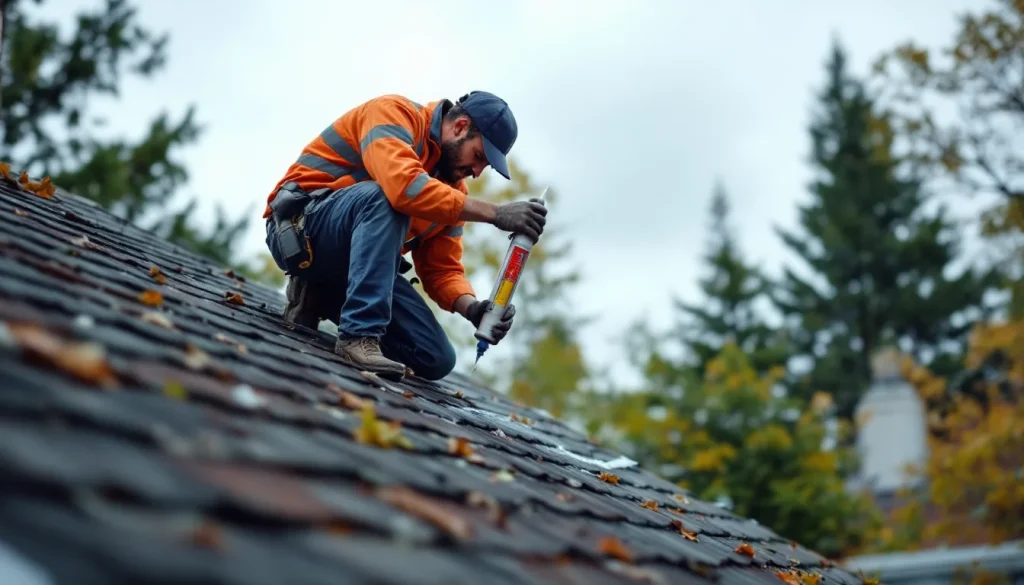
Roof leak repair (see our roof repair cost guide) in 2026 costs between $300 and $1,500 for typical residential repairs, but the real expense compounds with every week you delay. The actual fix depends entirely on where the leak originates: flashing failures account for roughly half of residential leaks, followed by missing or curled shingles, valley issues, and improper vents. Here is what each costs and which ones you can handle yourself, plus the specific repair materials and warranty implications that separate a five-year fix from a five-month patch.
The short version
- Typical roof leak repair runs $300 to $1,500 in 2026, with the median residential job landing near $600 to $850 depending on access and pitch.
- Flashing failures cause 40 to 50 percent of residential leaks, per NRCA field data and IBHS post-storm assessments. Shingle damage, vent boots, and valleys round out the top five.
- Vent pipe boot replacement is the most reliable DIY job: $20 to $40 in materials, one hour of work on a low-slope roof.
- Step flashing repair, valley work, and any repair above a 6/12 pitch should go to a licensed roofer. OSHA 1926.501 requires fall protection above six feet.
- Insurance covers sudden leaks (storm, fallen tree) but not gradual leaks from deferred maintenance. Document everything before you call.
- If you have three or more active leaks, or the roof is over 18 years old, repair money is often better spent on replacement.
The Short Answer: Repair Cost by Leak Source
Costs below reflect 2026 national medians for asphalt shingle roofs with normal access. Steep-slope (above 7/12), two-story, or tile and slate roofs run 30 to 80 percent higher. Pricing assumes a licensed contractor with a one-year workmanship warranty.
| Leak Source | Frequency | DIY Material Cost | Pro Repair Cost | Typical Lifespan of Fix |
|---|---|---|---|---|
| Vent pipe boot | ~15% of leaks | $20 to $40 | $150 to $400 | 12 to 15 years |
| Missing or cracked shingles | ~20% of leaks | $30 to $80 | $200 to $600 | Remaining roof life |
| Step flashing (wall) | ~25% of leaks | Not DIY | $400 to $1,200 | 20+ years |
| Chimney flashing | ~15% of leaks | Not DIY | $500 to $1,800 | 20+ years |
| Valley leak | ~10% of leaks | Not DIY | $600 to $2,400 | 15 to 25 years |
| Skylight flashing | ~5% of leaks | Not DIY | $400 to $1,600 | 15 to 20 years |
| Ice dam damage | Seasonal | $50 to $200 (heat cable) | $300 to $1,500 | Until next ice event |
| Nail pops | ~5% of leaks | $10 to $20 | $150 to $300 | 15+ years |
For the bigger picture on how leaks influence the repair vs replace math, see our breakdown of the signs you need a new roof and the running totals in our new roof cost guide.
The 7 Most Common Roof Leak Sources
Field data from NRCA member contractors and IBHS post-storm research points to a consistent ranking of leak (see our water stain on the ceiling) sources on asphalt shingle roofs. Knowing the ranking matters because water rarely enters where it appears inside the house. A wet spot above the kitchen table can trace back ten feet up the rafter to a chimney flashing gap. Working through suspects in order of likelihood saves hours.
- Step flashing at walls and dormers. The largest single category. Bent, missing, or buried-in-caulk pieces.
- Chimney flashing. A four-piece system, and any one failure opens a path.
- Missing, curled, or cracked shingles. Visible damage from the ground or from a drone shot.
- Vent pipe boots. EPDM rubber collars crack predictably at 10 to 15 years.
- Valleys. Where two roof planes meet, water concentrates and old metal corrodes.
- Skylight perimeter flashing. Curb-mounted and deck-mounted skylights both leak, just differently.
- Ice dams. Northern climates, January and February, water backs up under the field shingles.
Two honorable mentions: nail pops (where a roofing nail backs out and breaks the shingle above it) and ridge cap failures (especially on cut-shingle ridges done before 2010 when stamped ridge products were not standard).
Flashing Leaks: 40 to 50 Percent of Residential Roof Leaks
Flashing is the metal that bridges the roof and any vertical surface, penetration, or transition. NRCA training materials and field-loss data from major insurance carriers consistently put flashing-related leaks at 40 to 50 percent of residential roof leak claims. The reason is mechanical: shingles handle water sheeting down a slope, but every wall, chimney, skylight, vent, and valley breaks that flow and needs a separate water management system.
The three flashing locations that account for most of these calls:
- Chimney flashing. The four-piece system (base, step, counter, cricket) was rarely installed correctly on homes built before 2005. Replacement on an existing chimney runs $500 to $1,800 with a competent roofer. Add $300 to $700 if a cricket (the small diverter behind the chimney on the upslope side) is required by IRC R903.2.1 because the chimney is wider than 30 inches.
- Wall-roof transitions (step flashing). Where a roof meets a vertical wall (think dormers, second-story walls, or porches under a higher roof line). Step flashing is a series of bent metal pieces, one per shingle course. If a previous roofer caulked over it instead of weaving new pieces in, you get a five-year leak guaranteed.
- Skylight flashing. Velux and other major manufacturers sell pre-formed flashing kits matched to specific skylight models. If the original installer used generic flashing or caulk, expect a leak within ten years.
For a dedicated walkthrough of flashing-only repairs and material choices, see our roof flashing repair guide.
Missing, Curled, or Cracked Shingles
Visible shingle damage is the easiest leak source to identify and often the cheapest to fix. A single missing three-tab shingle in the middle of a field can be replaced for $200 to $400 by a pro, or $30 in materials and an hour of work by a competent homeowner on a low-slope roof.
The complications:
- Color match. Shingles fade. A replacement bundle from the same SKU will look obviously brighter for two to three years. Pulling matching shingles from a less-visible plane (back of the house) and using the new bundle there is the contractor trick.
- Adhesive bond. Shingles seal to the course below via thermal activation of the factory-applied adhesive strip. Replacements on a north-facing slope in winter may never seal without a six-spot dab of roofing cement under each tab.
- Sequential damage. If one shingle blew off in a windstorm, the surrounding shingles likely lost bond too. A pro will check 6 to 12 feet around the visible damage and reseal as needed.
Curled shingles are a different story. Curling is age-related (typically 18+ years on an architectural shingle, sooner on a three-tab). Once a roof field shows widespread curling, individual repairs are throwing money at a roof that is past its service life. Compare the cost against our roof replacement cost calculator output before committing.
Valley Leaks: Where Two Roof Planes Meet
Valleys carry concentrated water volume. A 1,000-square-foot roof can dump 200 to 300 gallons of water through a single valley during a heavy storm. That concentration is why valleys are a leak hotspot and why valley repair is rarely a DIY job.
Valleys come in three styles:
| Valley Type | Construction | Typical Lifespan | Repair Difficulty |
|---|---|---|---|
| Open metal valley | Exposed metal channel, shingles cut back 6 inches on each side | 30 to 40 years | Medium (metal swap) |
| Closed-cut valley | Shingles from one side run through, other side cut back 2 inches | 20 to 25 years | High (full strip and rebuild) |
| Woven valley | Shingles from both sides interlace | 15 to 20 years | High (full strip and rebuild) |
Valley leak repair on an open metal valley can run $600 to $1,500 because the metal often needs replacement and the surrounding shingles need to be carefully lifted and re-seated. Closed-cut and woven valleys frequently require a partial strip and rebuild, pushing costs to $1,500 to $2,400. If the underlying ice-and-water shield was omitted (common on pre-2007 roofs in mild climates), the leak will return until that membrane is added.
Vent Pipe Boot Failure: The 10-to-15-Year Problem
Plumbing vent stacks penetrate the roof and are sealed with a rubber-collared metal flange called a pipe boot. The EPDM rubber collar has a service life of 10 to 15 years in most climates, shorter in high-UV regions like Arizona, Nevada, and west Texas. When the rubber cracks, water runs down the stack and into the attic.
This is the most homeowner-friendly leak repair on the list:
- Material: Replacement boot ($15 to $35) or a Perma-Boot or Lifetime Tool retrofit collar ($25 to $45) that slides over the existing flange.
- Time: 30 to 60 minutes on a low-slope roof.
- Tools: Flat pry bar, hammer, roofing nails, tube of polyurethane sealant (Geocel 2300 or NPC Solar Seal 900). Skip silicone, which fails on asphalt.
- Skill level: Beginner to intermediate, low-slope only.
The retrofit collar option is worth knowing about. Instead of removing the failed boot (which means lifting shingles above it), you slide a polyurethane sleeve over the existing flange and seal it with two clamps. Twenty-minute job, no shingle disturbance, $25 to $45 at any roofing supply. Manufacturer data on the Perma-Boot II claims a 20-year service life.
Skylight Leak Repair
Skylight leaks are rarely from the glass itself. They come from the flashing perimeter, the curb-to-roof joint, or condensation that mimics a leak. Diagnosing requires checking each potential source in order:
- Run a hose across the upslope side of the skylight for 10 minutes. If water shows up inside, the upslope head flashing is the culprit.
- Hose the left and right sides next. Side flashing leaks are usually step flashing pieces that have separated or been buried in caulk.
- Hose the downslope side last. Downslope leaks are rare but happen when the apron flashing was bent incorrectly.
- If no hose test produces a leak but the inside shows water, suspect condensation, especially in kitchens and bathrooms.
Permanent skylight flashing repair using a Velux ECW kit or equivalent runs $400 to $900 in materials and labor on an existing curb-mounted unit. Deck-mounted skylights (more common after 2015) use a different kit but similar cost. Full skylight replacement runs $800 to $2,500 installed and is often the right move on units older than 20 years.
Ice Dam Damage Leaks
Ice dams form when attic heat melts snow at the upper roof, the water runs down to the colder eave, and refreezes. Water backs up under the shingles and finds the path of least resistance into the house. This is a winter-specific leak pattern and a known problem in IRC climate zones 5, 6, 7, and 8.
Three repair tracks:
- Acute repair after damage: Once water has penetrated, document interior damage, dry out the wall and ceiling cavities, and inspect the eave assembly. Repair cost ranges from $300 (drywall and paint) to $3,500 (insulation, decking, drywall, paint).
- Heat cable as a band-aid: $50 to $200 in materials, plug-in cables along the eaves. Effective for prevention, not a long-term fix.
- Real fix: Add attic insulation to R-49 or higher (IECC 2021 climate zone 5+), seal attic air leaks, and verify soffit-to-ridge ventilation. Cost: $1,500 to $4,000 in attic work. This is the only durable solution.
Step Flashing vs Counter Flashing: Why Both Matter
Step flashing and counter flashing form a two-layer system at any wall-roof intersection. Step flashing is the L-shaped metal piece that sits between each shingle course and the wall. Counter flashing is the metal that comes down from the wall (cut into mortar or behind siding) and covers the top edge of the step flashing.
If you only have step flashing and the installer caulked the wall siding directly down to the shingles, that caulk joint fails in five to seven years and you leak. If you only have counter flashing and no step flashing underneath, every shingle course is a potential entry point. You need both. IRC R905.2.8.3 requires step flashing on asphalt shingle roofs at wall transitions.
Repairing this correctly means lifting siding (or cutting into masonry to reset counter flashing), weaving in new step pieces, and replacing the counter flashing on top. Cost: $400 to $1,200 per 10-foot wall transition.
DIY-Safe Roof Leak Repairs ($30 to $150 in Materials)
A short, honest list of repairs that a competent homeowner can do on a low-slope (under 6/12 pitch), single-story, ranch-style roof without specialized equipment:
- Vent pipe boot replacement using a retrofit collar (Perma-Boot, Oatey Master Flash, or similar). $25 to $45.
- Single missing shingle replacement in the field of the roof. $30 to $60 for a partial bundle.
- Exposed nail head sealing on ridge caps with a dab of polyurethane sealant. $10 for a tube.
- Tarp installation as an emergency measure before pro arrives. $40 to $80 for tarp and furring strips.
- Gutter cleaning to address overflow-driven fascia rot that masquerades as a roof leak. $0 to $40 in tools.
OSHA 1926.501 requires fall protection above six feet of working height. The agency does not regulate homeowners on their own roofs, but the physics of a fall do not care who you work for. A harness, rope, and a roof anchor cost $150 to $300 and have saved more lives than any tool in the box. Use them.
Pro-Only Roof Leak Repairs
The list of repairs that should always go to a licensed roofer:
- Any work on a roof above 7/12 pitch.
- Two-story or taller installations.
- Tile, slate, or metal roof leaks (specialized fasteners and lifting techniques).
- Chimney flashing replacement (masonry cuts required for new counter flashing reglet).
- Valley leak repair (concentrated water volume, complex shingle weaving).
- Step flashing on dormers and second-story walls.
- Anything involving roof decking replacement or structural rot.
- Multi-layer tearoff repairs (where two or more layers of shingles exist).
If you are sizing up a contractor for any of these, our guide to how to choose a roofing contractor walks through license verification, insurance proof, and warranty structure.
Roof Leak Repair Materials That Actually Work
The repair-aisle products at big-box stores are mostly priced for one-time consumer use and often perform poorly long-term. The materials that pros use, and that homeowners can buy at roofing supply houses:
| Product | Use Case | Approximate Cost | Field Lifespan |
|---|---|---|---|
| Henry 208R wet patch | Emergency leak stop on wet surface | $15 to $25 per gallon | 1 to 3 years (temporary) |
| Karnak 19 ultra rubberized | Permanent flashing and seam repair | $35 to $55 per gallon | 10 to 15 years |
| Geocel 2300 ProFlex | Flashing and joint sealant, all weather | $8 to $12 per tube | 15 to 20 years |
| NPC Solar Seal 900 | Premium tripolymer sealant | $12 to $18 per tube | 20+ years |
| GAF MatchPoint | Color-matched shingle sealant | $15 to $22 per tube | 15 to 20 years |
| Grace Ice and Water Shield | Self-adhered membrane at valleys, eaves | $80 to $130 per roll | 30+ years (covered) |
Three pieces of product wisdom from working roofers:
- Silicone is the wrong sealant for asphalt shingle roofs. It does not bond well to mineral granules and degrades faster under UV than polyurethanes. Use Geocel, Karnak, or another polyurethane or tripolymer product.
- Wet patch products are temporary. Henry 208R is brilliant in a rainstorm at midnight, but it should be replaced with a proper flashing repair within six months. The asphalt cement migrates and the bond fails.
- Self-adhered membranes are the underrated repair material. A 36-inch-wide roll of Grace Ice and Water Shield turns a leak-prone valley into a problem-free one for the next 25 years.
What “Patch” Means vs “Real Repair”
When a contractor says “patch,” they usually mean caulk and asphalt cement applied over the symptom area. This is a six-month to two-year fix. When they say “repair,” they should mean lifting shingles, replacing the failed component (flashing, boot, valley metal), and re-seating the courses around it. That is a 10-to-20-year fix.
The price difference is real but not as large as homeowners think: a patch on a chimney flashing might be $250 versus $900 for a proper repair. The patch lasts 18 months; the repair lasts two decades. The math heavily favors the real repair on any roof with five or more years of expected service life remaining.
Ask the contractor specifically: “Are you going to remove and replace the failed component, or are you sealing over it?” Get the answer in writing.
When a Leak Means Full Roof Replacement
The repair vs replace decision turns on five questions:
- How old is the roof? An asphalt shingle roof has an installed service life of 18 to 28 years depending on product class. Past 18 years, repair money has diminishing returns. Our asphalt shingle roof lifespan guide has the breakdown by class.
- How many active leaks? One leak is a repair. Three or more leaks (separate sources, not one leak showing up in three places) signals systemic failure.
- What does the field look like? Curled, brittle, granule-loss shingles across the field mean the roof is past its service life. New flashing on a worn-out field is wasted money.
- Has decking rotted? Spongy spots underfoot or visible deflection from below the deck means structural compromise.
- Will insurance pay? If a storm caused the damage, the carrier may fund a full replacement. If gradual wear caused it, repairs are on you.
The cleanest decision rule: if repair quotes exceed 30 percent of the replacement cost on a roof older than 15 years, replace.
Insurance Coverage for Sudden vs Gradual Leaks
Standard HO-3 homeowners policies cover sudden and accidental damage. They exclude gradual deterioration, lack of maintenance, and wear and tear. That distinction drives every roof leak claim outcome.
Covered scenarios:
- Wind blew off shingles in a documented storm.
- Hail damaged the roof field (see our hail damage threshold guide).
- A tree fell and punctured the roof.
- Sudden ice dam damage (varies by carrier and state).
Not covered:
- Boot cracked from age and leaked.
- Flashing rusted out after 20 years.
- Granule loss from normal weathering.
- Leak from a roof that was past its service life when the storm hit (carrier may depreciate ACV heavily).
If you are filing a claim, document everything before the adjuster arrives. Our walkthrough on filing an insurance claim for roof damage and what an insurance adjuster looks for during a roof inspection covers the documentation and adjuster meeting in detail.
Regional Climate Considerations
The same roof leak can have very different repair scope depending on where the house sits. Climate, code adoption, and material weathering all shift the math.
| Region | Most Common Leak Source | Typical Repair Cost Adjustment | Code/Material Note |
|---|---|---|---|
| Pacific Northwest (OR, WA) | Moss-related shingle damage | Baseline | Heavy moss prevention required, see moss removal guide |
| Mountain West (CO, UT, ID, MT) | Ice dam leaks | +15% to +30% | Ice and water shield 36 inches minimum at eaves |
| Northeast (NY, MA, ME, VT, NH) | Ice dams, chimney flashing | +10% to +25% | R-49 attic insulation now required (2021 IECC) |
| Southeast (FL, GA, SC, NC) | Wind-driven rain at flashing | +10% to +30% | Hurricane-rated fasteners, secondary water barrier in FL |
| Gulf Coast (TX, LA, MS, AL) | Wind damage, hail | +10% to +25% | FORTIFIED Roof program available, may qualify for insurance discounts |
| Southwest (AZ, NV, NM) | UV-degraded boots, sealants | Baseline to -10% | Vent boots fail at 7 to 10 years instead of 12 to 15 |
| Midwest (IL, IN, OH, MI) | Hail, ice dams | +5% to +20% | Class 4 impact-rated shingles common, see hail damage guide |
Two practical implications: contractors in high-risk regions price differently because they expect more callbacks under storm load, and material choices shift (Class 4 shingles in hail country, higher-grade flashing in coastal regions). When comparing quotes across markets, normalize for these regional factors.
The Hidden Cost: Interior Damage
Roof leak repair pricing in this guide covers the roof side of the work. The interior damage from even a short-duration leak adds materially to the total bill. Realistic interior costs:
| Interior Damage | Typical Repair Cost |
|---|---|
| Drywall patch + paint (single ceiling area) | $200 to $600 |
| Insulation replacement (wet batt or blown-in) | $300 to $1,200 |
| Mold remediation (small area, 10 sq ft) | $500 to $1,500 |
| Mold remediation (large area, 30+ sq ft) | $2,500 to $6,000 |
| Framing repair (single rafter or joist) | $800 to $2,500 |
| Flooring replacement (water-damaged hardwood, single room) | $2,000 to $5,000 |
A 24-hour active leak that produces a wet ceiling spot typically adds $300 to $800 of interior repair. A six-week active leak that has run into walls, soaked insulation, and grown mold can add $4,000 to $12,000. This is why same-week tarp installation and same-month permanent repair matter so much.
Emergency Tarp vs Permanent Fix
When water is actively coming through the ceiling at 2 a.m., a tarp is the right answer. The right tarp install:
- Heavy-duty 8 mil or thicker poly tarp, sized to cover the leak source plus three feet on every side.
- Roll the upslope edge around a 2×4 furring strip and secure under the shingle course above the leak so water cannot run under.
- Secure the downslope and side edges with furring strips screwed into the deck.
- Avoid driving roofing nails through the tarp into the deck without sealant. Every penetration is a future leak.
A correctly installed emergency tarp lasts three to six weeks. Beyond that, UV degrades the poly and wind tears it free. Schedule the permanent repair within that window. Cost of a tarp install: $40 to $80 in materials if you do it, $400 to $900 if a roofer comes out at night.
For the step-by-step process of moving from emergency tarp to permanent repair, see our companion guide on how to fix a roof leak. The companion piece walks through the garden hose test, materials selection by leak type, and the documentation pros use to verify a fix actually held through the first storm. Pair these two guides with a written maintenance plan from our roof maintenance schedule and the inspection cadence in how to get a roof inspection to convert reactive leak chasing into a predictable annual cost.
FAQs
How long does a typical roof leak repair last?
A proper repair to a single failure point (boot, flashing piece, missing shingles) should last 10 to 20 years if the surrounding roof has equivalent service life remaining. A patch over the same failure typically holds 18 months to two years. Ask for component replacement, not sealant-over-symptom work.
Can I repair a roof leak from the inside?
No. Interior repairs (drywall, paint, insulation) are part of restoring the house, but the leak source is on the exterior side of the roof assembly. Sealing the ceiling does not stop water entry. It just hides where the water is going while it rots the framing.
How long can I wait to repair a roof leak?
Days, not weeks. A 24-hour active leak is usually a $300 to $1,500 repair. A six-week active leak adds drywall, paint, insulation, and possibly framing repair, pushing total cost to $2,500 to $8,000. Tarp it within 24 hours and schedule the permanent repair within two to three weeks.
Will my homeowners insurance cover a roof leak repair?
Only if the leak was caused by a covered peril (wind, hail, fallen tree, sudden accident). Leaks from age, wear, or deferred maintenance are excluded under standard HO-3 language. If a storm preceded the leak, file a claim and document the storm date.
What is the cheapest roof leak to fix?
Vent pipe boot replacement using a retrofit collar like Perma-Boot. $25 to $45 in materials, 30 to 60 minutes of work. Single missing shingle replacement is a close second at $30 to $60.
What is the most expensive roof leak to fix?
Valley leaks on a steep tile or slate roof, or chimney flashing repairs where the chimney needs a new cricket and counter flashing reglet cut into masonry. Those can run $2,000 to $4,500 on a complex install.
Should I try to find the leak source myself before calling a roofer?
Yes, with caveats. A garden hose test on a dry day can confirm or rule out specific sources (start downslope, work up, run each section for 10 minutes with a helper inside watching for water). Just stay off the roof if you do not have a harness and the pitch is over 6/12.
How do I find a good roofer for a leak repair?
Three filters: state license verification, current general liability and workers comp insurance proof (not just a certificate, ask for the carrier name and call), and a written scope that says “replace failed component” rather than “seal as needed.” Our contractor selection guide goes deeper.